Sudan Regional Response
Sudan Regional Response
On this page
A Humanitarian and Development Crisis
Sudan’s conflict has triggered the world’s fastest-growing displacement crisis. Sudan has the largest number of internally displaced people in the world, with over 9 million individuals. Sudan is also home to 862,000 refugees. In neighbouring countries, 3.5 million Sudanese refugees and asylum-seekers have been newly displaced since April 2023, and together with previously displaced people make up the second-largest refugee population globally and the largest on the African continent. In a large-scale repatriation movement, over 873,800 South Sudanese refugees in Sudan have also fled back to South Sudan. Nationals of the Central African Republic, Chad and Ethiopia have also returned to their home countries under adverse circumstances. Without a resolution to the crisis, millions more people may be forced to flee in search of safety, protection, and basic assistance, jeopardizing peace and stability across the region.
The Sudanese people have repeatedly faced internal conflicts since the country’s independence. The economic toll of this latest escalation has been particularly devastating, and the World Bank expects the conflict will set Sudan’s development back several decades. The World Bank estimates that Sudan’s real GDP contracted by 12% in 2023, and the African Development Bank projects a more severe decline up to 37%, driven by destruction of production capacity and disruptions to economic activities. Deepening state fragility, the collapse of basic services, and a contraction of the economy are expected to hinder reconstruction and recovery.
Regional ramifications of the Sudanese emergency are extensive – particularly in neighbouring Chad, South Sudan, Egypt, Ethiopia, and the Central African Republic, as well as in Uganda and Libya. All these countries are grappling with an influx of refugees – as well as returning citizens for some – fleeing the devastating conflict into areas that are often impoverished and have limited access to basic social services and economic opportunities. Further movements to Kenya, Eritrea and Tunisia have been recorded, as well as onward to Europe, in search of protection, assistance, and livelihood opportunities.
The conflict is a significant economic shock for the entire region. The IMF has indicated that severe spillovers from the conflict in Sudan could exacerbate the humanitarian and macroeconomic situation in neighbouring countries. Disruptions to supply chains and local cross-border trade have also impacted economies across the region. Countries assisting those displaced via integrated settlement approaches in rural areas and urban responses in cities span from the Red Sea and the Horn of Africa to the Sahel Region. They include six low-income countries - the Central African Republic, Chad, Ethiopia, South Sudan, Sudan, and Uganda – and two middle-income countries – Egypt and Libya. Together, they account for approximately 25% of the African continent’s population.
Internal and international conflicts, the UN Economic Commission for Africa warns, are major hurdles that directly and detrimentally affect progress towards the UN Sustainable Development Goals (SDGs) in Africa. Many SDGs will remain out of reach without a comprehensive approach to address the humanitarian, development and peacebuilding needs and challenges in Sudan and neighbouring countries. The immense scale and duration of the Sudan regional refugee crisis necessitate development responses both in Sudan and in countries of asylum.
In accordance with its mandate, UNHCR coordinates the Sudan regional refugee response, working with +111 partners across the region. Humanitarian and development partners are scaling up programs in displacement-affected areas to deliver lifesaving assistance, facilitate access to basic services, build community resilience, stabilize local economies and consolidate peace gains.
To support efforts by development partners to respond to the Sudan emergency, UNHCR and UN Development Coordination Office (UNDCO) have established a Development Partners Group for the Sudan Regional Refugee Crisis. This nexus approach is in line with UNHCR’s commitment to pursue “solutions from the start” of an emergency.
Regional Map
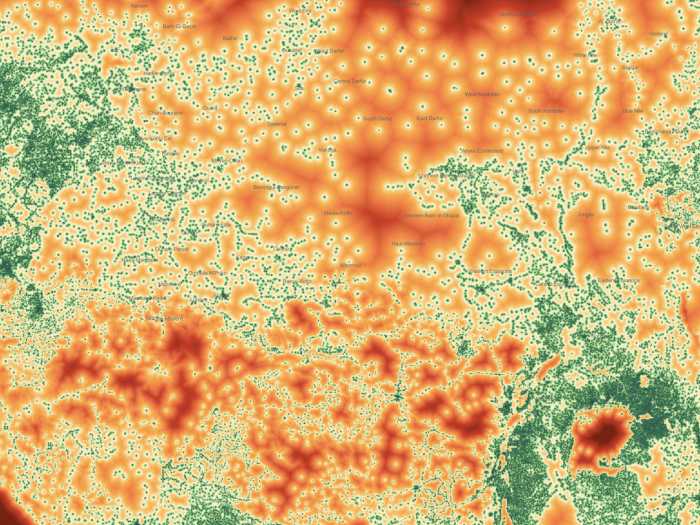
Regional Map
The Sudan Crisis Regional Map is a first-of-its-kind, multi-stakeholder data integration tool that delivers a comprehensive view of the Sudan crisis across eight countries. It brings together a wide range of spatial data within a single interactive platform, enabling users to visualize and customize data in real time to identify needs, assess vulnerabilities, and target interventions.
Ongoing Development Interventions
MMC Dashboard: Regional Mixed Movements
Data source: The Mixed Migration Centre (MMC) conducted interviews with 3,554 refugees and migrants who fled the Sudan war to Chad, Ethiopia, South Sudan, and Eastern Sudan. Interviews were conducted between August 2023 and September 2024. This interactive report provides insights into the profiles, experiences, and onward movement intentions of the respondents. It was developed as part of a collaboration with the United Nations High Commissioner for Refugees (UNHCR) and the Danish International Development Agency (DANIDA).
UNHCR Operational Data Portal
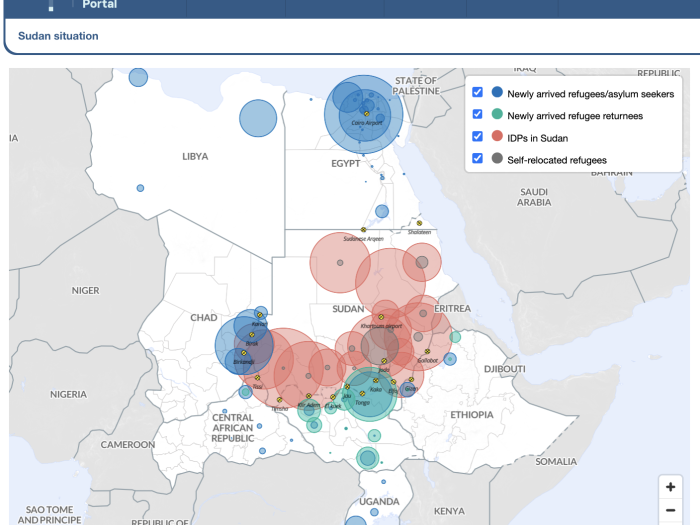
UNHCR Operational Data Portal
The Operational Data Portal (ODP) enables UNHCR's institutional responsibility to provide an information and data sharing platform to facilitate coordination of refugee emergencies. The ODP for the Sudan situation collects the latest data, dashboards, publications, and updates.