
Advocacy Note on Emergency Agricultural Support in Sudan (2026-2028)
Author(s)
Abstract
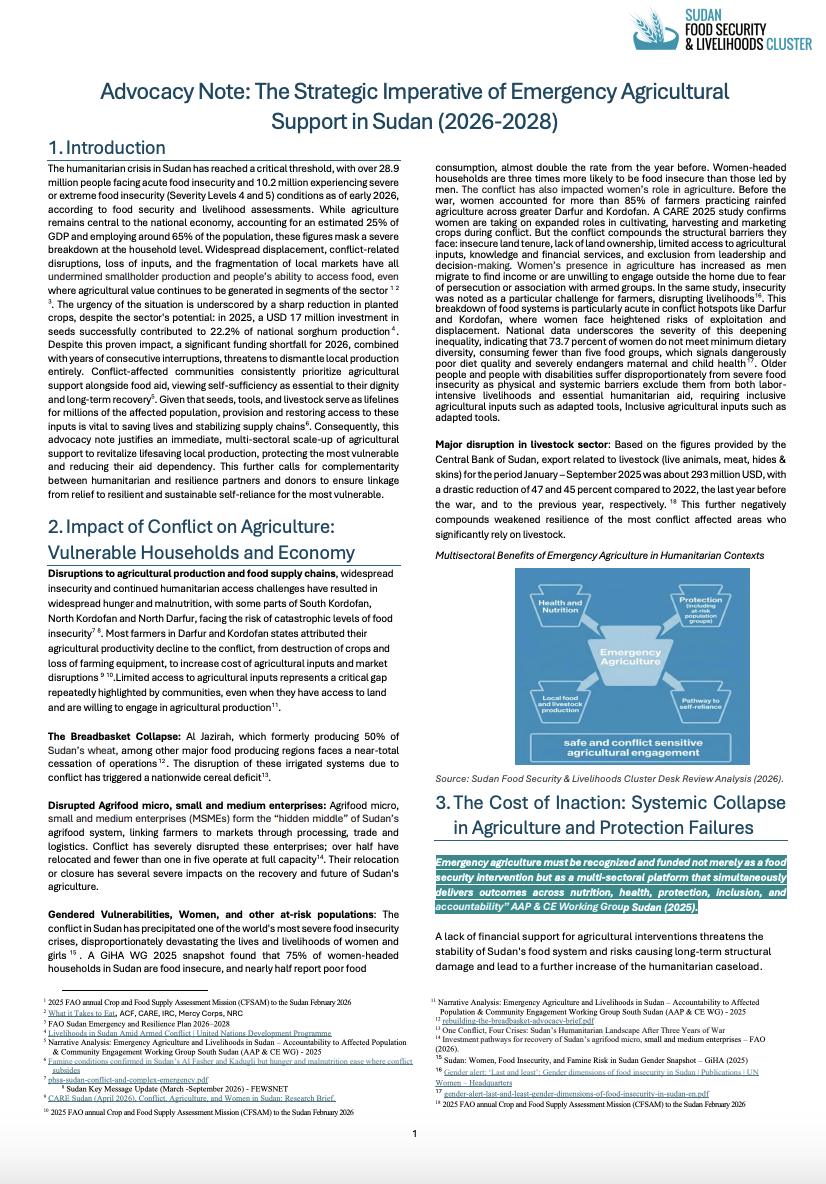
The humanitarian crisis in Sudan has reached a critical threshold, with over 28.9 million people facing acute food insecurity and 10.2 million experiencing severe or extreme food insecurity (Severity Levels 4 and 5) conditions as of early 2026, according to food security and livelihood assessments. While agriculture remains central to the national economy, accounting for an estimated 25% of GDP and employing around 65% of the population, these figures mask a severe breakdown at the household level. Widespread displacement, conflict-related disruptions, loss of inputs, and the fragmentation of local markets have all undermined smallholder production and people’s ability to access food, even where agricultural value continues to be generated in segments of the sector. The urgency of the situation is underscored by a sharp reduction in planted crops, despite the sector's potential: in 2025, a USD 17 million investment in seeds successfully contributed to 22.2% of national sorghum production. Despite this proven impact, a significant funding shortfall for 2026, combined with years of consecutive interruptions, threatens to dismantle local production entirely. Conflict-affected communities consistently prioritize agricultural support alongside food aid, viewing self-sufficiency as essential to their dignity and long-term recovery. Given that seeds, tools, and livestock serve as lifelines for millions of the affected population, provision and restoring access to these inputs is vital to saving lives and stabilizing supply chains. Consequently, this advocacy note justifies an immediate, multi-sectoral scale-up of agricultural support to revitalize lifesaving local production, protecting the most vulnerable and reducing their aid dependency. This further calls for complementarity between humanitarian and resilience partners and donors to ensure linkage from relief to resilient and sustainable self-reliance for the most vulnerable.