
Sudan Poverty and Equity Brief: October 2025
Author(s)
World Bank
Report
Abstract
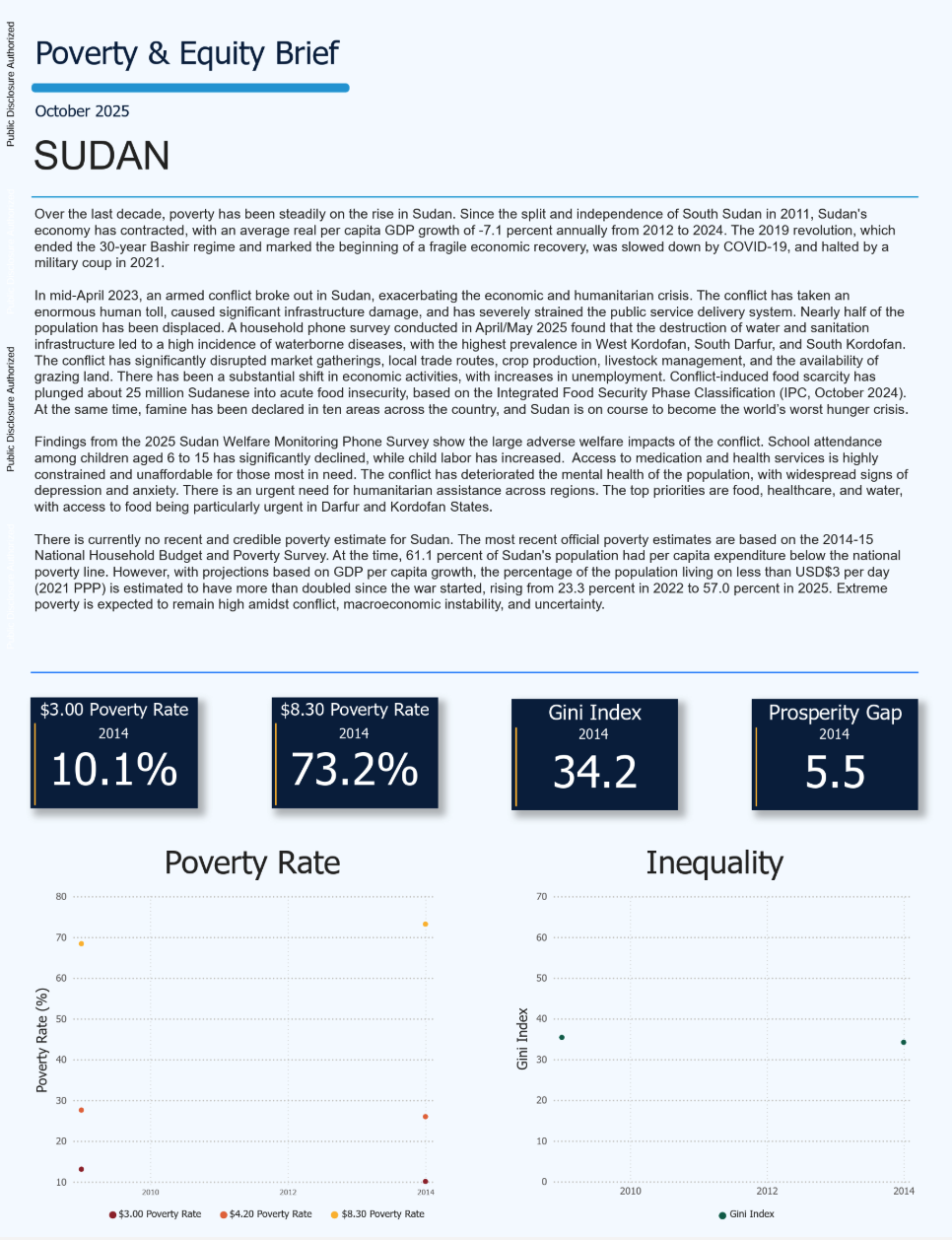
Over the last decade, poverty has been steadily on the rise in Sudan. Since the split and independence of South Sudan in 2011, Sudan's economy has contracted, with an average per capita GDP growth of -4.6 percent annually from 2012 to 2023. The 2019 revolution, which ended the 30-year Bashir regime and marked the beginning of a fragile economic recovery, was slowed down by COVID-19 and halted by a military coup in 2021. Currently, there are no recent and credible poverty estimates for Sudan, with the most recent official estimates based on the 2014-15 National Household Budget and Poverty Survey, which indicated that 61.1 percent of Sudan's population had per capita expenditure below the national poverty line. However, projections based on GDP per capita growth suggest that the percentage of the population living on less than USD 2.15 per day (2017 PPP) has more than doubled since the war started, rising from 33.3 percent in 2022 to 69.3 percent in 2025. Extreme poverty is expected to remain high amidst ongoing conflict, macroeconomic instability, and uncertainty.