Sudan

Sudan
On this page
Sudan in Crisis
Sudan is facing the world’s largest humanitarian, protection, displacement, and hunger crisis. The country remains particularly susceptible to climate change and environmental disasters, primarily floods and drought, which exacerbate existing vulnerabilities and increase the risk of intercommunal violence and humanitarian needs. Conflict-related environmental damage, including explosive hazards and war debris, will also continue to pose a threat far into the future. Sudan’s multitude of complex challenges represent one of the greatest development challenges on the African continent.
As of May 2026, an estimated one in three Sudanese has been forcibly displaced. Sudan has the world’s largest internally displaced population, with 8.9 million people forcibly displaced within the country since April 2023. The conflict has also driven over 4.4 million people to flee to seven neighbouring countries in search of safety and basic assistance.
The situation in Sudan remains incredibly complex with more displacement happening every month into Chad, South Sudan and other neighbouring countries. At the same, Sudanese displaced persons are returning to and within – an estimated 4.2 million since 2025 – and these people need to be supported in areas of return even as the conflict continues in other parts of the country.
Sudan simultaneously ranks as one of the largest refugee-hosting countries in Africa, with 866,749 refugees and asylum-seekers living within its borders (UNHCR 30 April 2026). The country has stayed steadfast in its commitment to host refugees and has kept its borders open despite its own internal struggles. Sudan is also a source, transit, and destination country for refugees, asylum-seekers and migrants across the sub-region towards Europe and the Middle East.
Recommended Priority Investments
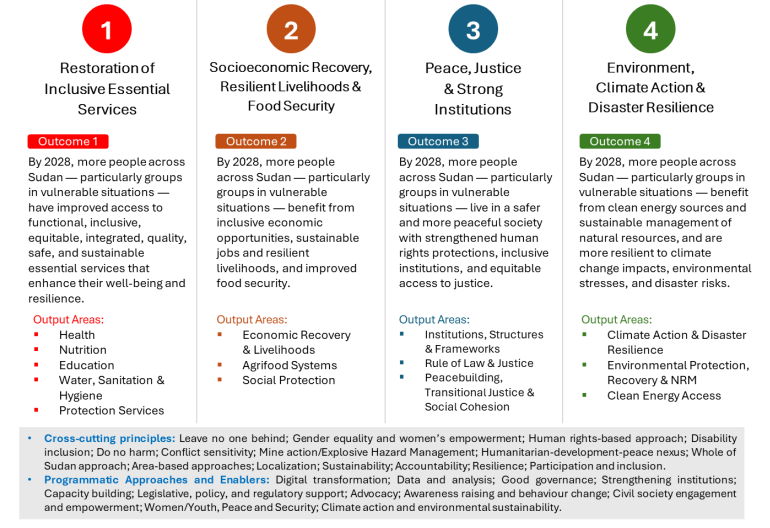
The Interim UN Cooperation Framework 2026–2028 outlines the following priority investments to advance recovery, resiliency, and peace efforts in Sudan:
- Restoration of inclusive essential services
- Socioeconomic recovery, resilient livelihoods, and food security
- Peace, justice, and strong institutions
- Environment, climate action, and disaster resilience
The United Nations in Sudan advocates for area-based responses to the conflict which are inclusive of all the forcibly displaced – IDPs, refugees, asylum-seekers and returnees – alongside host communities as they have all been adversely affected and have become increasingly reliant on humanitarian aid as the conflict rages on. The competition for resources and assistance is high between the communities, and without support to build community resilience and social cohesion, the risks and likelihood of tensions arising are significant, adding to the already complicated conflict profile of the country.

Source: Interim UN Cooperation Framework Theory of Change (UN Interim Cooperation Framework Sudan 2026-2028, p.11)
Spotlight on the Returnee Population

Spotlight on the Returnee Population
An increasing number of displaced Sudanese are returning to and within Sudan, particularly to parts of the country where hostilities have subsided, with the intention to begin the process of rebuilding their lives after more than three years of conflict.
Spotlight on the Refugee Population in Sudan
Sudan has a long-standing tradition of hosting refugees and has for decades generously kept its doors open to people fleeing conflict and persecution. It ranks as a country that has provided protection for one of the longest periods - nearly six decades (since 1967). Sudan has kept its borders open to new refugees arriving, and over 93,828 new arrivals have sought asylum in the country during the period January 2025-April 2026, mainly from Eritrea, Ethiopia and South Sudan.
Prior to April 2023, Khartoum hosted the largest number of refugees (approximately 310,000), followed by White Nile State, Kassala State and East Darfur State. An estimated 70% of the refugees lived outside of camps, within local communities in towns and villages that host them on their land. States with the largest out of camp populations included Khartoum, White Nile, West Kordofan and South Darfur. The remaining 30% of the refugees live in 22 camps across four states. The conflict has had the biggest impact in Khartoum, Al Jazirah, Kordofan and Darfur States, where not only government services, national infrastructure and local economies have collapsed, but also where many refugees and asylum seekers are located. Nearly one third of all refugees have since the war began been secondarily displaced within Sudan, and now the largest hosting states of refugees are White Nile, Kassala and Gedaref.
Even as the conflict rages on, the refugee population numbers remain stable. However, assistance trends are shifting, and the number of refugees dependent on assistance has grown, as refugees who were previously self-reliant in urban areas affected by the conflict have sought safety and assistance in the existing camps. UNHCR estimates that 65 to 70% of the refugee population now live in camps.
The secondary displacement of refugees inside to Sudan to relatively safer states have put strains on already limited resources, infrastructure and social services. This comes on top of myriad ongoing challenges, including limited access to healthcare, employment opportunities, as well as multiple protection issues, including sexual violence and family separation. The dire circumstances in which they find themselves often exacerbate their vulnerability, leaving them susceptible to exploitation, violence and human rights abuses. Refugee children are often deprived of their rights, such as the right to access essential services, live in a protective family environment, birth registration and healthcare.
Partners


Data in Sudan

Data in Sudan
Curated by the UNRCO Sudan, this catalogue of data and evidence summarizes publications produced since the start of the conflict in Sudan in April 2023.
Sudan Welfare Monitoring Survey (WMS)

Sudan Welfare Monitoring Survey (WMS)
The World Bank’s Sudan Welfare Monitoring Survey (WMS) has been calling households since October 2024, swiftly capturing shifts in displacement, assets, food security, mental health, education and employment. This data seeks to inform policy priorities and project design by the World Bank and other development actors.
Documents Library - Sudan



Contacts
UNDP: Yui Suzuki Arai, Partnership and Programme Analyst ([email protected])
UNHCR: Richmond Msowoya, Livelihood and Economic Inclusion Officer ([email protected])
UN-Habitat: Wala Abdelmuati, Representative ([email protected])
ILO: Stephen Opio ([email protected])