

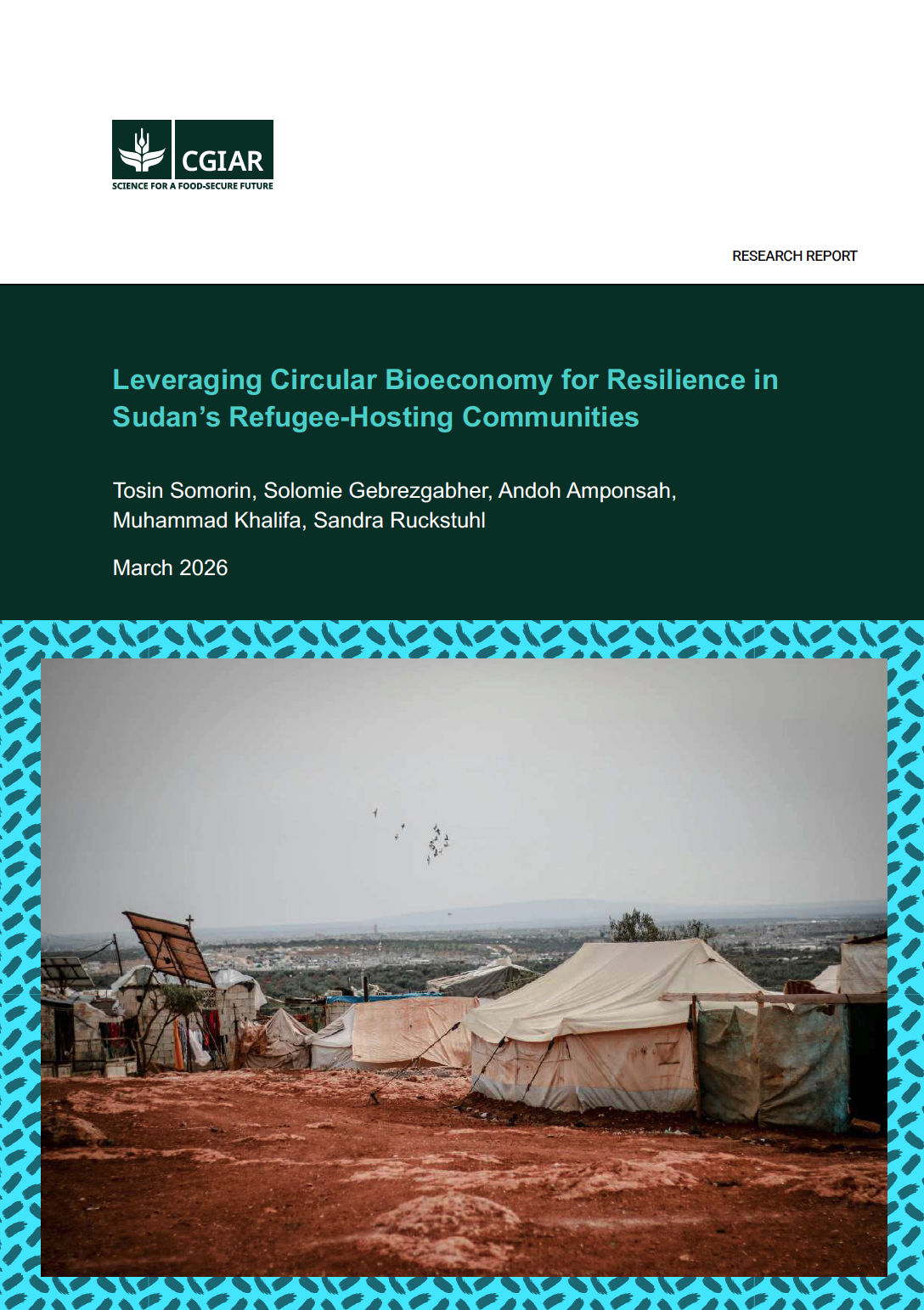
Leveraging Circular Bioeconomy for Resilience in Sudan’s Refugee-Hosting Communities
Author(s)
Abstract
Sudan’s overlapping crises of conflict, displacement, climate stress, and service collapse have pushed millions of people into extreme vulnerability, placing unprecedented pressure on food, water, energy, and sanitation systems in refugee-hosting regions. This paper explores how circular bioeconomy approaches can transform these pressures into opportunities for resilience in three highly affected states: White Nile, Gedaref, and Kassala. Drawing on a desk-based assessment and evidence from comparable humanitarian contexts, the study identifies practical, low-infrastructure pathways that convert locally available organic waste and by-products into food, energy, soil inputs, and livelihoods.
The analysis highlights five priority entry points: nutrient recycling for food system resilience; decentralized bioenergy for clean cooking and basic services; feed production for displaced livestock; small-scale wastewater reuse and greywater irrigation; and community-based bioproduct enterprises. Together, these pathways demonstrate how waste streams can be reframed as assets that strengthen self-reliance, reduce environmental degradation, and ease pressure on overstretched humanitarian systems.
Embedding CBE within the humanitarian–development–peace nexus, the paper shows how circular solutions can position displacement settings not only as sites of need, but as spaces for innovation, regeneration, and recovery that simultaneously meet immediate needs and build longer-term adaptive capacity. It provides actionable guidance for humanitarian and development actors seeking scalable, context-sensitive interventions that deliver co-benefits for the environment, society, and the economy.
Future work will prioritize field-based assessments, co-design with displaced and host communities, and partnerships with humanitarian actors to ground-truth waste flows, assess health safeguards, and develop state-specific implementation models that can be piloted and scaled under real operational conditions.