
Korsi
Korsi
On this page
Introducing Korsi
Korsi is a neighbourhood on the outskirts of Birao, the capital of Vakaga prefecture. Located in northeastern Central African Republic (CAR) near the Sudanese border, Vakaga prefecture covers an area of 46,500 km2 and had a population of 52,255, according to the 2003 census. The security situation remains volatile in Vakaga, where the presence of non-state armed groups and banditry continues to hinder humanitarian access and pose protection risks for civilians.
In April 2023, the Government of the CAR selected Korsi neighbourhood to host thousands of Sudanese refugees fleeing violence in Darfur. Before the Sudan crisis, Korsi was sparsely populated by Central African families living off farming and small trade. Since the refugee influx, Korsi has expanded rapidly and shelters more than 22,328 Sudanese refugees (double the number of host community members), primarily women and children. Additionally, about 6,652 internally displaced persons (IDPs) affected by conflict in 2019 are present in three nearby sites.
In the local language, Sango, Korsi means "welcome". As of January 2026, the Commission Nationale pour les Réfugiés - CNR (the National Refugee Commission) and UNHCR registration teams biometrically registered 779 new refugee arrivals (248 households) in 2026 in Korsi. (Unlike in previous years, when a significant number of arrivals were observed in Korsi at the beginning of the year, in 2026 UNHCR noted that other towns in Vakaga Prefecture welcomed new arrivals, notably Sikikédé, Manou, and Ouandja-Djallé). Humanitarian partners, in collaboration with local authorities, have set up key protection services. A new mixed committee of refugees and host-community leaders has been created to strengthen intercommunal communication, collaboration, and solutions. Registration and awareness-raising activities are ongoing to ensure access to services.
Korsi is located close to essential infrastructure, including schools, local administration, hospitals, and the regional base of the UN peacekeeping mission in the CAR. The 2007 National Asylum Law grants refugees various rights under the same conditions as nationals, including access to services and employment. Nevertheless, significant challenges remain due to remote access, insecurity, and limited infrastructure.
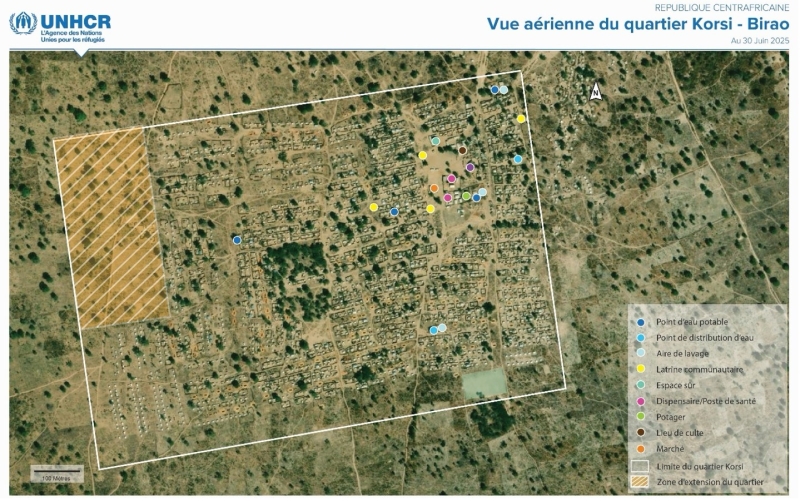
Map

Education
In Birao, at the start of the 2025-2026 school year, there were more than 12,800 Sudanese refugee children aged 3 to 17, including 2,460 preschoolers, 7,776 primary schoolers, and 2,598 secondary schoolers (October 2025). Furthermore, there are 2,799 youth aged 18 to 24.
By the second trimester of the school year, over 1,280 refugees were attending various public primary schools across the town of Birao, representing about 33% of enrolments at those schools. There are slightly more boys enrolled than girls, with girls accounting for only 47% of enrolments.
Over the last year and a half, nine new classrooms were built in Birao public schools to enable schools to absorb more students into the national education system.
Key interventions also include language support programs to help Arabic-speaking refugees transition to the French curriculum, as well as teacher training on language fluency and pedagogy. French bridging courses are offered in Birao, and a weekly French conversation club was launched in June 2025 in Korsi.
Health
In collaboration with the Vakaga Health District through the Birao district hospital, humanitarian partners have been providing primary and secondary health care services to both refugees and host communities. Construction has begun on a health centre in the Ibongbi neighbourhood.
Vakaga prefecture is severely affected by the disease outbreak. In April 2025, the WHO reported a hepatitis E epidemic centred in Sikikédé and Birao, where 98% of confirmed cases were linked to contaminated wells (WHO, April 2025).
In Korsi neighbourhood, Acute Respiratory Infections (ARIs) are the leading cause of medical consultations among refugees, according to the WHO’s outbreak surveillance system data (EWARS). Limited access to safe WASH facilities aggravates health conditions, increasing the risk of communicable disease outbreaks and straining local health infrastructure. WHO and partners are working to strengthen epidemic surveillance, provide technical support, and health services (WHO, April 2025).
WASH
Access to safe drinking water remains a critical challenge in Korsi. Three boreholes currently supply 111,000 litres per day to some 22,328 people, providing an average 11,5 litres per person, well below the Sphere standard of 15 litres. Two other manually operated boreholes are also operational, but their utilisation rates are currently being studied to determine daily water output based on the refugees’ usage. The “Ekimba” project, funded by the World Bank, has also built three human-powered boreholes that are not yet operational. Once operational, they will help increase the amount of water supplied to each person per day.
220 semi-permanent household latrines are operational in Korsi, and another 150 are nearing completion. Over 15,000 people urgently need improved sanitation, requiring the construction of 3,750 additional family latrines. UNICEF’s partner Triangle Génération Humanitaire (TGH) is constructing additional water and sanitation facilities.
Shelter
In Korsi, where approximately 22,328 Sudanese refugees live, shelter coverage meets less than 23% of identified needs. In 2025, only 220 semi-durable shelters and latrines were being built, leaving thousands of families exposed to harsh weather and heightened protection risks. Many refugees remain without safe housing, increasing vulnerability during the rainy season.
Livelihoods
Local communities face significant resource constraints and depend largely on subsistence farming and pastoralism. Expanding sustainable employment and self-employment opportunities for Sudanese refugees and host populations in Vakaga and surrounding areas is therefore a priority. Two initiatives, led by FAO and UNHCR in partnership with CIAUD and MINUSCA, are working to strengthen vocational training and promote agricultural livelihoods (UNHCR, July 2025).
Key Resources
Contacts
UNHCR: Gloria Ramazani, External Relations Officer ([email protected])