
Education in Chad
Education in Chad
On this page
What is the vision for refugee inclusion in the education sector?
The Government of Chad and UNHCR outline the following vision for the education sector: “Refugee, stateless, internally displaced, asylum-seeking and returnee children and youth have access to inclusive and equitable quality education within the Chadian education system, which protects them while providing them with opportunities for preschool, primary, secondary, tertiary and vocational education in accordance with Sustainable Development Goal No. 4” (Education Strategy 2030 Chad). The Education Strategy outlines three key objectives, each supported by benchmarks, indicators, and targets to be achieved by 2030. These objectives are as follows:
- Objective 1: Strengthen the equitable inclusion of stateless refugees, internally displaced persons, asylum seekers, and returnees in the Chadian education system for quality education.
- Objective 2: Promote the maintenance of a safe and protective learning environment for all students and teaching staff.
- Objective 3: Strengthen coordination, partnerships, and leadership for better inclusion of refugees in the Chadian education system
Is there an enabling policy environment?
Chad has one of the lowest human capital indexes in the world. A Chadian child is expected to reach only 30% of his or hers potential by adulthood (Refugees in Chad: The Way Forward, 2022). Despite high rate unenrollment rates - 26.7% were not enrolled in primary school, 58.6% in middle school and 74.4% in secondary school in 2023 – the Government of Chad has made substantial efforts to include refugees in the education system and has adopted a progressive inclusion agenda.
The Government has committed to providing refugees with access to quality education by integrating them into the national education system. Article 21 of the 2020 Asylum Law specifies that every refugee or asylum-seeker in possession of individual documentation enjoys the right to education and vocational training under the same conditions as nationals. The same is reiterated by Article 65 of the 2023 Decree. This integration allows all refugees and asylum-seekers to enrol in primary, secondary, and higher education institutions, follow the Chadian curriculum, and obtain recognized diplomas. At the Global Refugee Forums in 2019 and 2023, the Government pledged to reinforce refugee inclusion in the national education system: by 2027, with the support of technical and financial partners, 50% of the teachers working sites serving refugees and hosts will be recruited by the Ministry of Education (MENPC).
Chad’s National Development Plan identifies education, water, and sanitation as priority sectors. The Plan Intérimaire de l’Education au Tchad (PIET 1) 2018- 2020 was initially to be followed by a ten-year plan. However, the severe economic crisis caused by the drop in oil prices, along with the worsening security situation in the Sahel, led national authorities to postpone the preparation of a ten-year plan. Instead, they opted to develop a three-year plan for 2022–2024 (PIET 2). This will be followed by a five-year plan covering 2026–2030, informed by lessons learned from PIET 2 and the sectoral analysis (RESEN) conducted in 2023. The interim period 2024–2026 is guided by the Partnership Compact, launched in 2023, which focuses on teacher quality and service delivery.
What do the national standards require?
In accordance with Law No. 016/PR/2006 on the Chadian education system and passed in 2006, the two official languages of instruction are French and Arabic. Chad’s education system includes primary (ages 6–11), lower secondary (ages 12–15), and upper secondary education (ages 16-18) education, forming the core of basic education. Post-baccalaureate options include vocational training and higher education. In addition, non-formal education targets out-of-school youth to support insertion into formal education and/or the labour market.
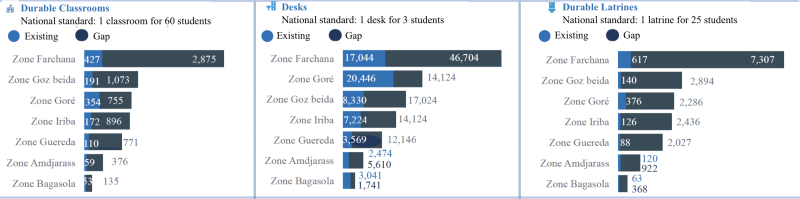
- Teacher to student ratio: 1 teacher for 60 students (primary), 1 teacher for 50 students (lower-secondary and upper-secondary)
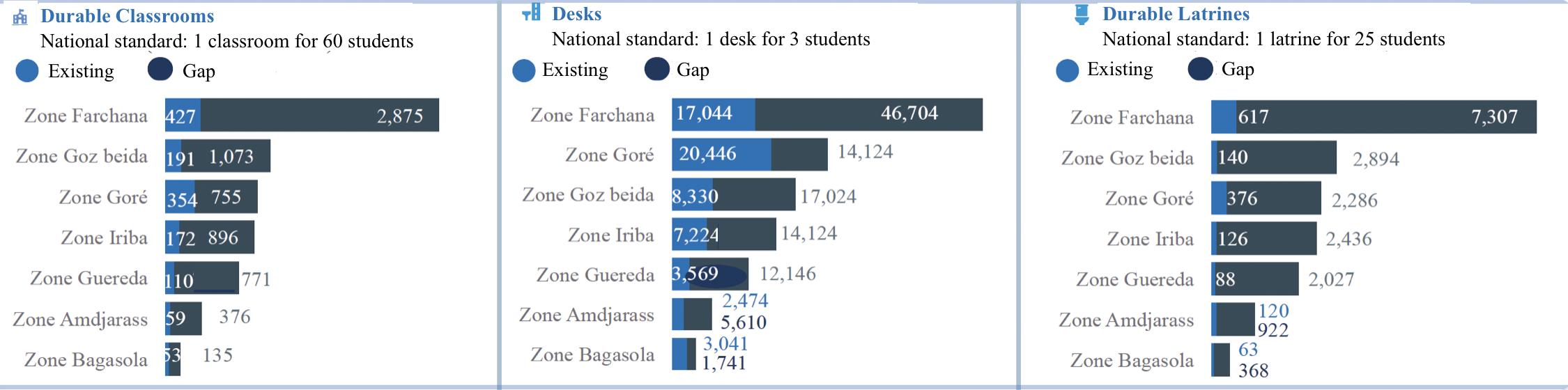
- Classroom to student ratio: 1 classroom for 60 students
- Latrine to student ratio: 1 latrine for 25 students
- Desk to student ratio: 1 desk for 3 students
Enrolment Rates
For Sudanese children in Eastern Chad, the percentage enrolment rates for the end of the academic year 2024-2025 are 18.6% for preschool, 63.6% for primary school, 25.7% for lower-secondary school and 14.5% for upper-secondary school. Overall, 38.8% of Sudanese children in Eastern Chad were enrolled in formal education as of June 2025. For a breakdown by province, gender, and level, see Tables 1 and 2.
For access to tertiary education, there are dedicated scholarship programmes for refugees in Chad, including the DAFI programme, a Mixed Movements scholarship, Mastercard Foundation and scholarships provided by the French Embassy. While scholarships are a crucial way to support refugee students, the number of refugees accessing tertiary education in Chad remains low. During the academic year 2024/2025, 1,614 scholarships supported refugee and host students to access tertiary education, of which 1,019 were Sudanese.
Area and Province | Table 1. School-Age Children as of June 2025 (Sources: JRS, UNHCR, NRC, Plan International) | ||||||||||||||
Preschool (3-5 years) | Primary (6-11 years) | Lower-Secondary (12-15 years) | Upper-Secondary (16-18 years) | Total | |||||||||||
Girls | Boys | Total | Girls | Boys | Total | Girls | Boys | Total | Girls | Boys | Total | Girls | Boys | Total | |
Ennedi Est | 3,418 | 3,338 | 6,756 | 5,069 | 4,986 | 10,055 | 3,021 | 2,586 | 5,607 | 1,925 | 1,717 | 3,642 | 13,433 | 12,627 | 26,060 |
Ouaddai | 20,638 | 21,155 | 41,793 | 43,428 | 43,224 | 86,652 | 23,348 | 23,469 | 46,817 | 14,018 | 12,861 | 26,879 | 101,432 | 100,709 | 202,141 |
Sila | 8,135 | 8,290 | 16,425 | 15,902 | 16,262 | 32,164 | 8,708 | 8,716 | 17,424 | 5,007 | 4,808 | 9,815 | 37,752 | 38,076 | 75,828 |
Wadi Fira | 13,817 | 13,489 | 27,306 | 25,051 | 24,576 | 49,627 | 12,581 | 12,139 | 24,720 | 7,974 | 7,285 | 15,259 | 59,423 | 57,489 | 116,912 |
Sudanese Children in Eastern Chad | 46,008 | 46,272 | 92,280 | 89,450 | 89,048 | 178,498 | 47,658 | 46,910 | 94,568 | 28,924 | 26,671 | 55,595 | 212,040 | 208,901 | 420,941 |
Area and Province | Table 2. Children Enrolled in School as of End of 2024/2025 Academic Year (Source: JRS, UNHCR, NRC, Plan International) | ||||||||||||||
Preschool | Primary | Lower-Secondary | Upper-Secondary | Total | |||||||||||
Girls | Boys | Total | Girls | Boys | Total | Girls | Boys | Total | Girls | Boys | Total | Girls | Boys | Total | |
Ennedi Est | 316 | 248 | 564 | 3,102 | 2,686 | 5,788 | 429 | 334 | 763 | 473 | 205 | 678 | 4,320 | 3,473 | 7,793 |
Ouaddai | 6,631 | 6,308 | 12,939 | 35,837 | 33,769 | 69,606 | 8,638 | 5,756 | 14,394 | 2,813 | 1,205 | 4,018 | 53,919 | 47,038 | 100,957 |
Sila | 635 | 565 | 1,200 | 8,268 | 9,633 | 17,901 | 2,654 | 2,162 | 4,816 | 797 | 621 | 1,418 | 12,354 | 12,981 | 25,335 |
Wadi Fira | 1,164 | 1,338 | 2,502 | 10,106 | 10,191 | 20,297 | 2,456 | 1,858 | 4,314 | 1,270 | 709 | 1,979 | 14,996 | 14,096 | 29,092 |
Sudanese Children in Eastern Chad | 8,746 | 8,459 | 17,205 | 57,313 | 56,279 | 113,592 | 14,177 | 10,110 | 24,287 | 5,353 | 2,740 | 8,093 | 85,589 | 77,588 | 163,177 |
What investments are required to deliver on the vision?
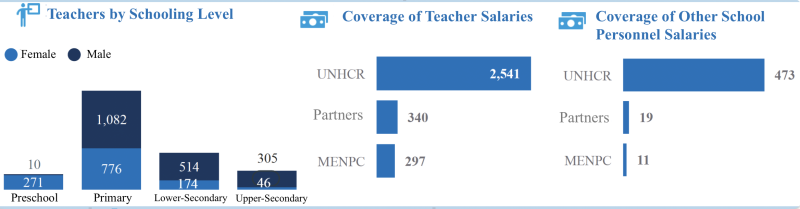
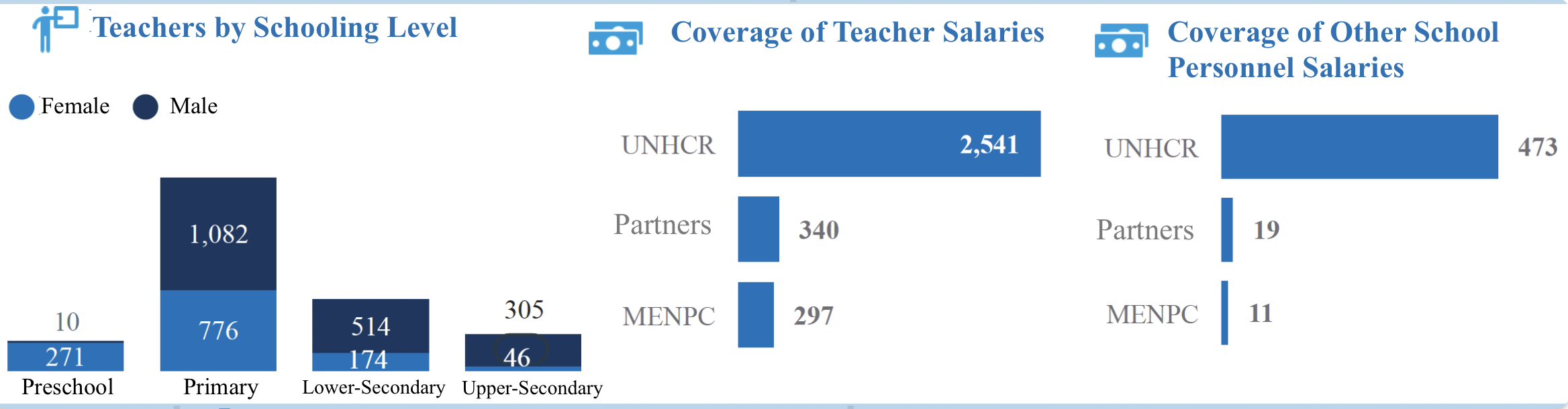
Key gaps are present in the number of durable classrooms, desks, and durable latrines for students in refugee-hosting areas (Image 1). A costing exercise is ongoing, and the results will be shared when available. Secondly, Image 2 captures the number of teachers recruited for schools in refugee-hosting areas, and the coverage of teacher salaries and other school personnel salaries as of June 2025. This data is at national level for Chad.
How can development actors support?
Effective, efficient, and innovative partnerships—along with strong coordination of educational activities—are essential to ensuring lifelong access to quality education for refugee and host community children.
Spotlight: The Mastercard Foundation in partnership with UNHCR and local institutions, supports programming across multiple levels of the education system in Chad, with a focus on gender inclusion, access to secondary and tertiary education, and academic advancement for both refugee and host communities. Between June and December 2024, the partnership contributed to improvements in enrolment, inclusivity, and teacher support in secondary education. Awareness campaigns encouraged families to prioritize their children's education, especially for girls, which contributed to a rise in enrolment. Access to tertiary education expanded through scholarships and institutional partnerships: 270 refugee students received scholarships via cash-based interventions. To advance digital inclusion, a Digital Learning Center is being developed to expand educational access for refugee and host community youth without requiring physical relocation.
Spotlight: Inclusion in Practice
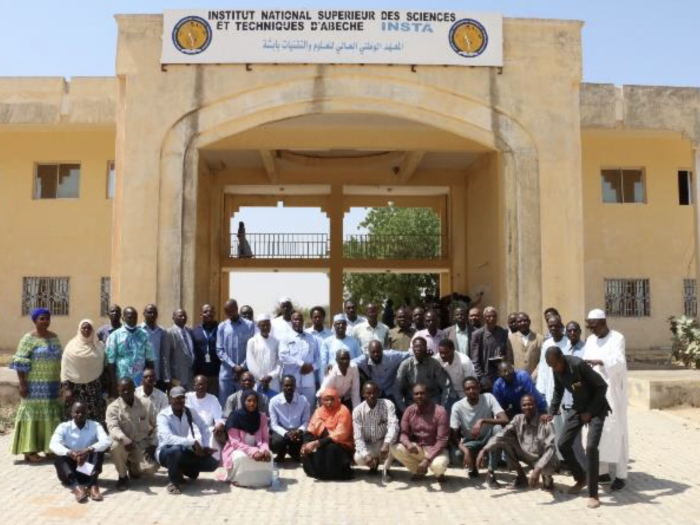
Spotlight: Inclusion in Practice
Sudanese and Chadian University Professors Exchange in Abéché
On February 19 and 20, 2025, two high-level meetings were held in Abéché between higher education teachers from Sudan and their Chadian colleagues from Adam Barka University (UNABA) and the National Institute of Science and Technology (INSTA). Facilitated by UNHCR, these meetings provided an opportunity for higher education faculty in Chad to connect with their Sudanese counterparts, who arrived following the April 2023 crisis. The gathering brought together Sudanese teachers and their Chadian counterparts from academic institutions in the East, with the goal of leveraging the human resources available among the refugees. During the event, both parties engaged in introductory sessions, allowing refugee professors to present their expertise to the administrative authorities of UNABA and INSTA. This was followed by constructive discussions on potential collaboration and academic staffing support. A total of 42 refugee professors from diverse academic backgrounds participated in the discussions.
Key Resources
Contacts
UNHCR: Benoit D'ansembourg, Education Officer ([email protected])