

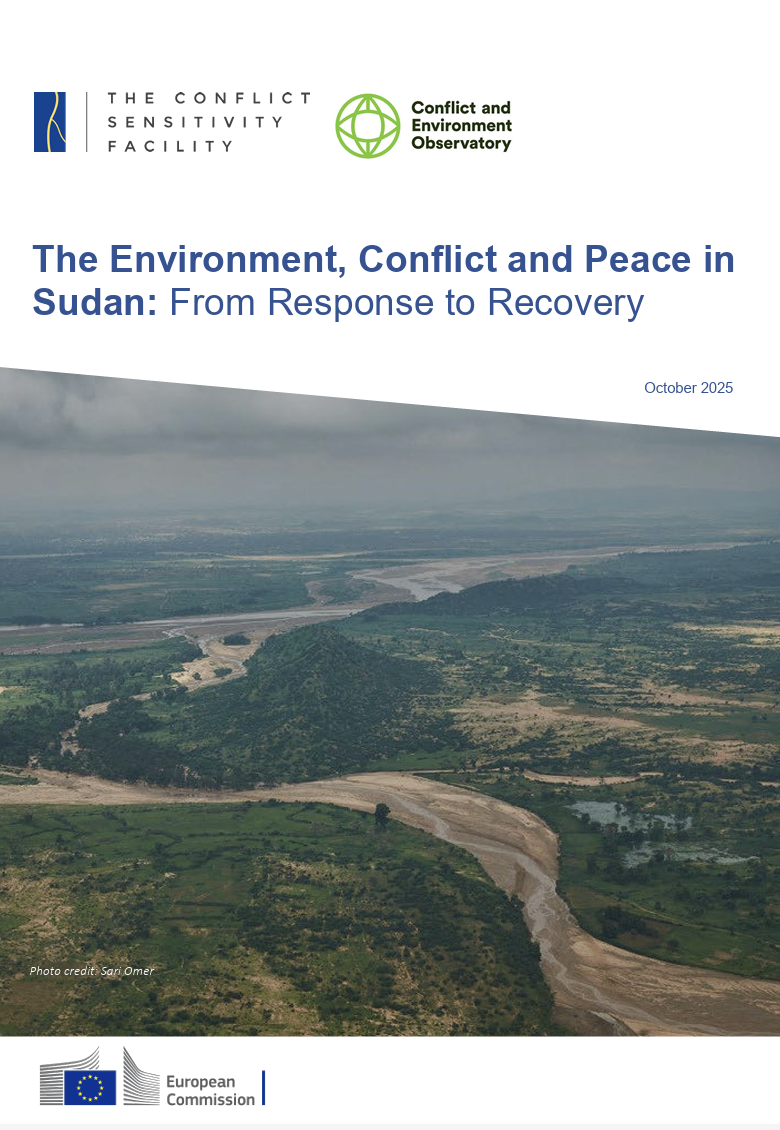
The Environment, Conflict and Peace in Sudan: From Response to Recovery - October 2025
Author(s)
Conflict and Environment Observatory (CEOBS)
Conflict Sensitivity Facility (CSF)
Report
Abstract
A new research paper examines how environmental factors shape conflict and peace in Sudan, urging their integration into humanitarian response and strategies for peace. Published by the Conflict Sensitivity Facility (CSF) and the Conflict and Environment Observatory (CEOBS), it highlights that environmental issues are critical and have both immediate and long-term implications for aid, political engagement, and future stability and recovery.
As the war continues, it is essential to understand and respond to the environmental implications of conflict. However, it is also important to keep sight of strategies for the longer-term and to support Sudanese expertise to prepare for the long road ahead – in particular civil society which have sustained a focus on environmental issues which they see as fundamental alongside having to rapidly adapt to the conflict and the humanitarian crisis.
Drawing on a literature review, interviews, and focus group discussions with Sudanese and international experts and practitioners, the study explores how weak governance, national policies, climate stresses, and insecurity intensified environmental pressures before the current war. Competition over natural resources such as oil and gold has been a key driver of local and national conflicts, while external interests in Sudan’s resources can both undermine and support peace efforts.
Despite their significance, environmental dimensions have received little attention amid the humanitarian crisis. The research identifies opportunities to embed environmental considerations in the aid response, centring Sudanese expertise and locally led approaches. Integrating natural resource management into local peacebuilding can enhance social cohesion and support gender equality, while shared environmental narratives can shift perceptions from competition to cooperation.
Key recommendations include:
- Integrating environmental considerations as a key component of impactful strategies to demand an end to the war and work towards sustainable peace by addressing root causes of both local and national drivers of conflict.
- Supporting Sudanese civil society working on environmental and peacebuilding issues despite the pressures of war.
- Embedding environmental and climate concerns into humanitarian, development, and peacebuilding programming to strengthen resilience, sustainability and conflict sensitivity.
- Ensuring that the environment, climate resilience, and sustainable resource management central to future governance and green recovery efforts.