
Research Highlights Way Forward for World Bank’s Window for Host Communities and Refugees (WHR)
Research Highlights Way Forward for World Bank’s Window for Host Communities and Refugees (WHR)
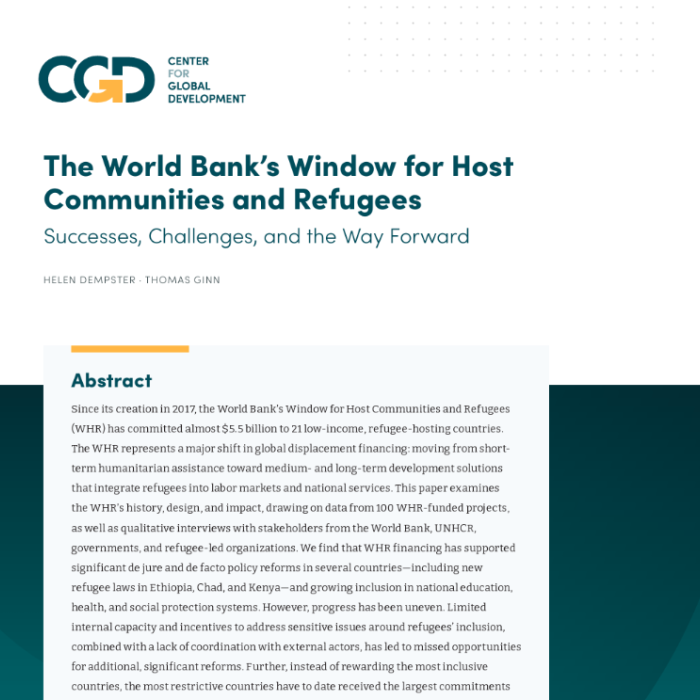
Text is cited from the blog post The World Bank's Model for Refugees Is Working, but It Could Be Even Better (Center for Global Development, 9 April 2026).
The World Bank’s WHR has delivered real results for refugees in its first eight years. With IDA22 talks now underway, the WHR could enhance its impact even more with targeted reforms.
The World Bank’s Window for Host Communities and Refugees (WHR) was launched in 2017 to address major challenges in the way the international community responds to refugees.
Many of the world’s 40 million refugees have lived in low- and middle-income countries for decades but are restricted from working and supporting themselves. In part because of these restrictions, the response is often short-term: emergency food aid, temporary shelters, parallel service delivery.
This approach must change. It violates refugees’ rights and international law; barely meets refugees’ basic needs—something which will become even more difficult in the wake of aid cuts—wastes scarce aid resources; and undercuts the economic benefits that refugees could bring to host countries.
The WHR therefore provides grants and concessional loans to low-income countries hosting significant refugee populations. Its goal is to move beyond short-term humanitarian aid towards medium- and long-term development solutions—both in terms of inclusive policies and development projects aiming for long-term returns—that integrate refugees into labor markets and national services while supporting host communities.
The Center for Global Development's new paper asks a fundamental question: Is the WHR the right model to accomplish this goal? Drawing on 33 interviews and analysis of its 100 projects, we explain the WHR’s structure, how it differs from most other financing, and its impact over the first eight years. We argue the WHR’s model is strong and progress is significant.
At the same time, the WHR has missed important opportunities to accomplish more. In this paper, we outline what management, staff, and the Board of Directors should do for the WHR to realize its full potential.
The WHR provides financing to five countries responding to the Sudan crisis: the Central African Republic, Chad, Ethiopia, South Sudan, and Uganda. To learn more, read the blog post and full paper by the Center for Global Development.