
Energy & Environment in Chad
Energy & Environment in Chad
On this page
Climate Change in Chad
Despite contributing minimally to global greenhouse gas emissions, Chad is among the world’s most climate-vulnerable countries, ranking first on the ND-Gain Index and fourth on the INFORM Risk Index Mid-2025. Its vulnerability stems from a hot climate, a poorly diversified economy, and limited adaptation capacity (IMF 2024). Agriculture, livestock, and oil dominate the economy, with farming and herding accounting for 40% of GDP and employing 75% of the population (IMF 2024). Limited irrigation, inefficient water use, and inadequate storage make agriculture highly sensitive to shifting rainfall patterns (PIK 2020). Energy access remains critically low, yet Chad holds vast untapped potential in solar and other renewables.
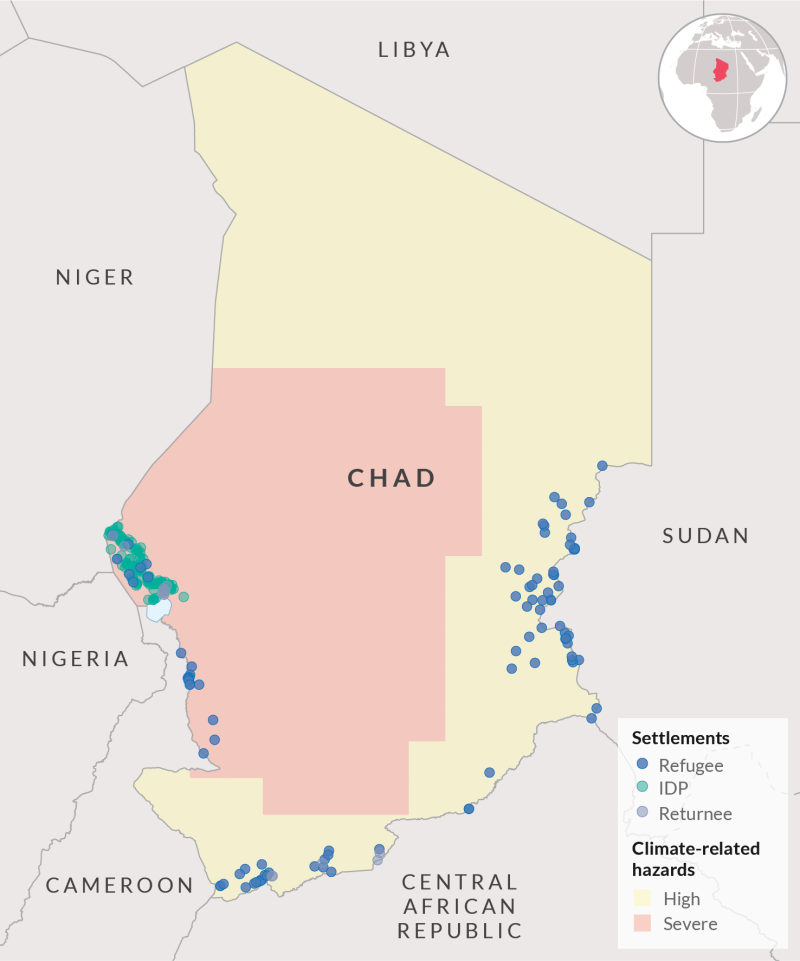
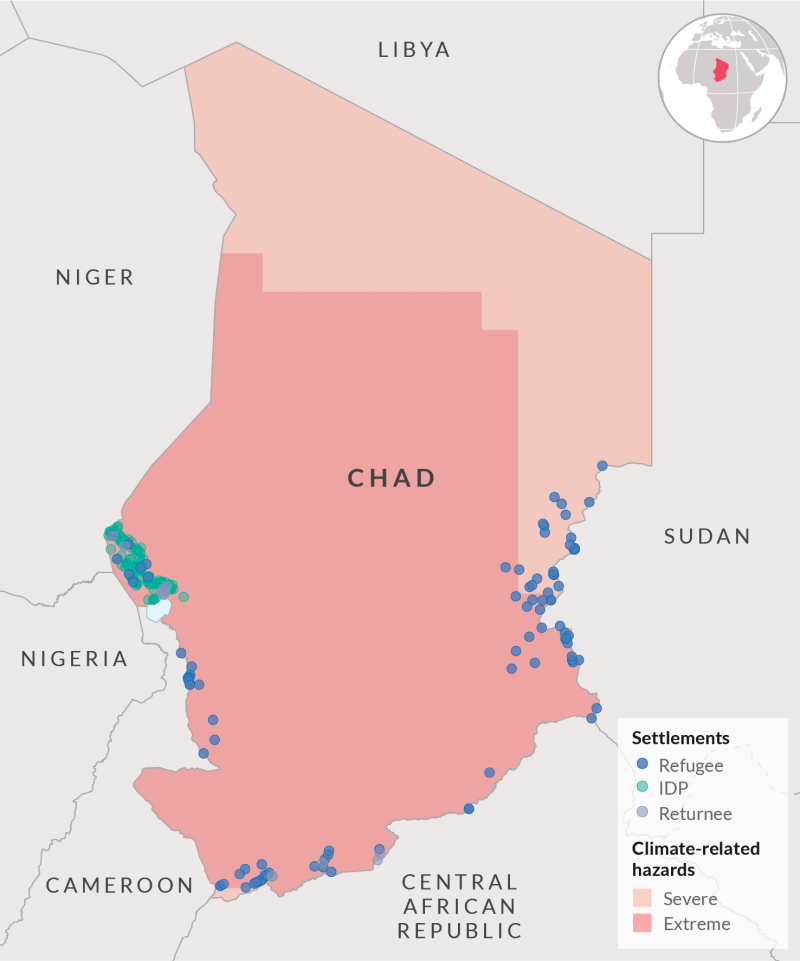
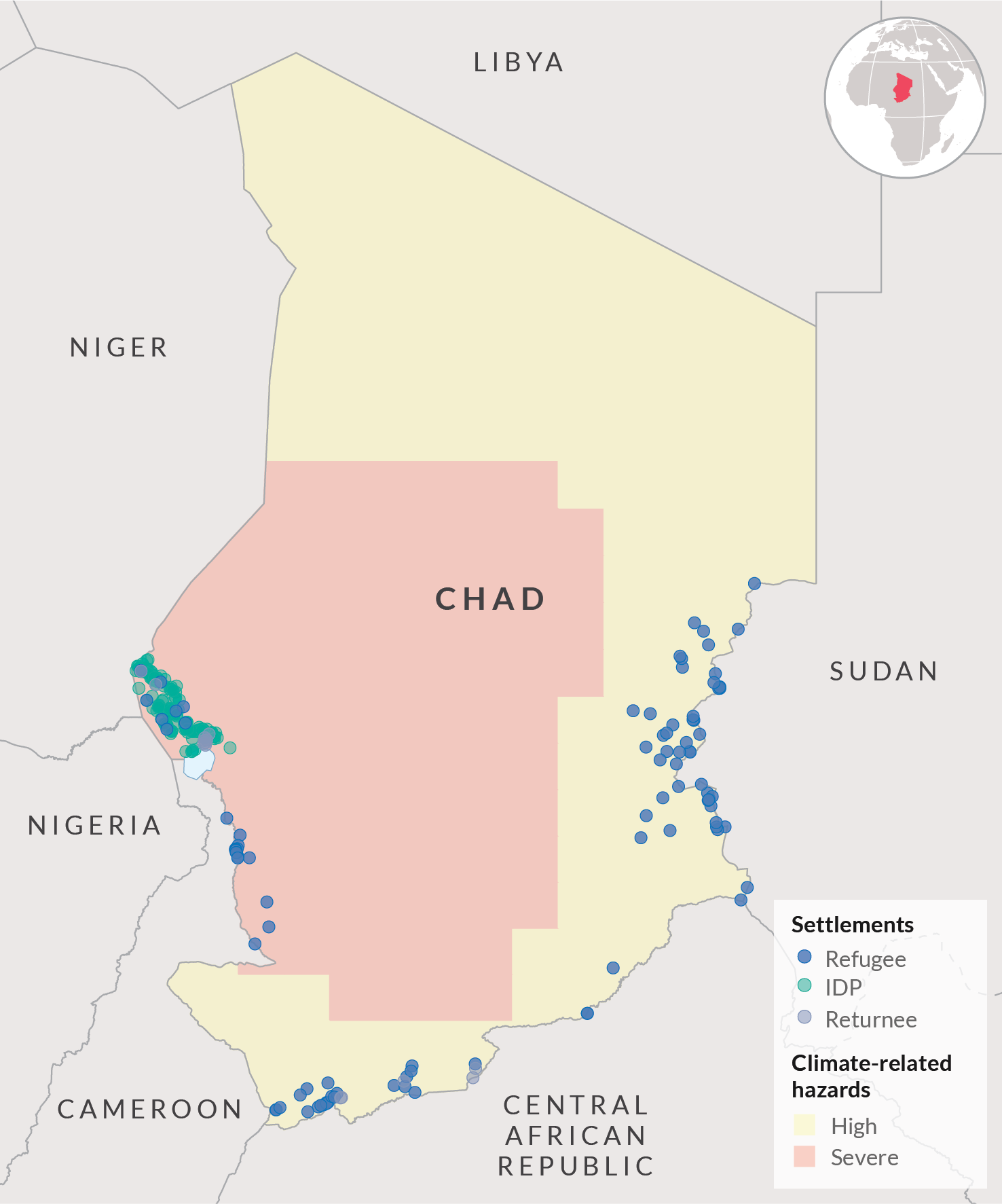
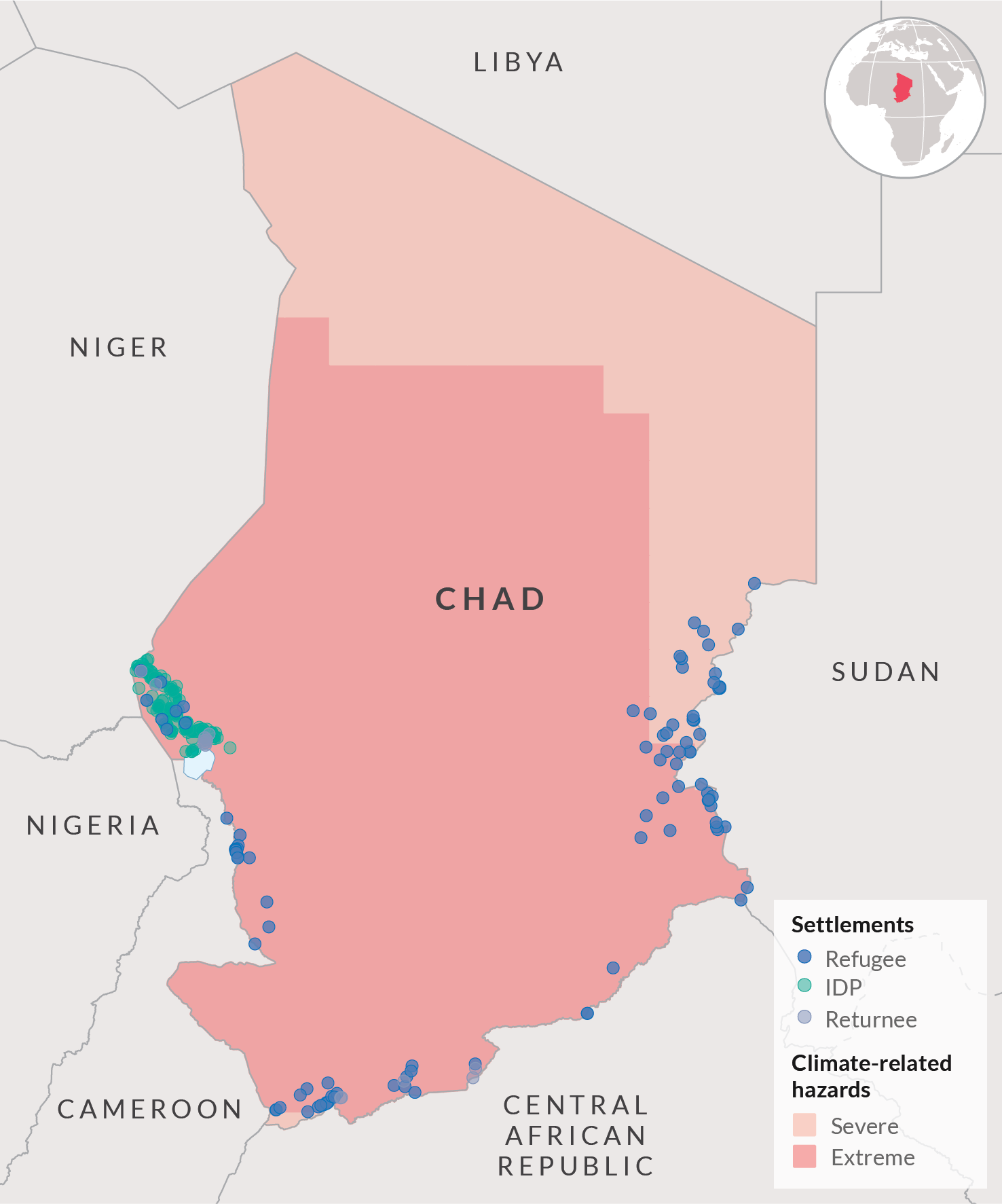
Climate change is driving desertification, soil and habitat degradation, and declining water resources. Chad could see average annual temperatures rise by 1.5–2.5°C by 2050, with shorter, more intense rainy seasons and prolonged dry spells, reducing groundwater recharge and crop yields, particularly for maize, millet, and sorghum (IPCC AR6, CORDEX-Africa). Extreme weather events, including flash floods, are increasing, while per capita water availability is expected to decline due to population growth (PIK 2020). Climate-related damages reached 12% of GDP in 2019, with projected losses exceeding 10% of GDP by 2050 under dry-climate scenarios (World Bank 2022). Displaced communities are particularly at risk, as refugee and IDP settlements are often located in areas prone to severe hazards (Figures 1 and 2).
How are displaced people affected by climate change?
Eastern Chad is subject to high climate variability and global warming and is located in the Sahelian zone, a transitional area between the Sahara Desert and the savannahs. Drought, declining levels of rainfall, and rising temperatures put rural livelihoods in Chad at risk (World Bank 2021). Access to water resources remains difficult due to the region’s hydrogeological characteristics and growing water stress. Heavy rains and flooding routinely destroy shelters and basic infrastructure and contaminate fresh water (UNICEF 2024). Refugees are severely affected by climate hazards, largely due to their exposure and limited adaptive capacities. Climate change also acts as a contributing driver of displacement in Chad. In 2024, floods displaced over 1.3 million people (IDMC 2024).
Energy in Chad
Chad has one of the lowest electricity access rates in the world at 6.4%, with significant disparities between rural and urban areas (World Bank 2021). The national electricity grid only serves N’Djamena and a few regional centers, including Sarh, Moundou, Abeche, and Faya. Energy shortages are particularly acute in refugee resettlements and host communities, posing serious security and health risks, especially for women and children (World Bank 2021).
Chadian businesses consistently rank energy access, after political instability, as their main challenge (IFC 2023). Power generation costs are very high – around 43 US cents per kilowatt-hour – making electricity among the most expensive in Sub-Saharan Africa. Chad's significant renewable energy potential remains largely untapped, particularly solar energy (IFC 2023).
Policy for Energy & Environment
Vision 2030, Pillar 4: A healthy environment and preserved natural resources
Chad’s Vision 2030 plan allocates an entire strategic pillar to environmental and climate issues. Pillar 4 aims to preserve natural resources and improve the quality of life by integrating climate adaptation and mitigation across development efforts. It promotes sustainable management (e.g. Lake Chad basin protection) and increased access to renewable energy to reduce dependence on wood and fossil fuels. This overarching framework guides concrete initiatives such as solar-powered water pumping and the promotion of clean cooking solutions (LPG or solar) in communities, including refugee camps. By 2030, the share of households with access to renewable energy is targeted to rise from 2% to 25%, linking environmental preservation with socio-economic resilience.
National Strategy to Combat Climate Change (SNLCC)
Adopted in 2017, the SNLCC outlines Chad’s roadmap for climate action through 2030, covering both mitigation of greenhouse gas emissions and adaptation to climate impacts. Its five strategic pillars include strengthening the resilience of agro-sylvo-pastoral systems, promoting mitigation actions (e.g., renewables, sustainable forestry) and expanding access to diversified and sustainable energy (solar, wind, butane). It also focuses on disaster risk prevention and institutional capacity building, including climate finance. The strategy reinforces sectoral alignment around climate goals, for example, off-grid solar pumping systems improve water security in drought-prone areas, and promoting clean fuels for cooking reduces forest degradation and exposure of women to violence during wood collection.
Masterplan for the Deployment of Renewable Energies
Adopted in 2018 and funded by the European Union, the masterplan lays out a roadmap for scaling up renewable energy in Chad with a focus on off-grid and hybrid solutions. It recommends installing solar minigrids, often with battery storage or diesel backup, to serve isolated communities. While primarily mitigation-oriented (reducing fossil fuel use and emissions), the plan also delivers concrete adaptation co-benefits, such as powering rural clinics, schools, and agricultural water systems. It aligns with Vision 2030 and the PND and broadens the definition of “modern energy” to include clean cooking alternatives like LPG, reinforcing national efforts to transition refugee camps away from polluting fuels and reduce environmental pressure.
National Electricity Emergency Plan (NEEP)
The Government of Chad launched the NEEP in July 2020, aiming to expand electricity access to 38% of the population by 2023 and 53% by 2030 (World Bank 2021). The Ministry of Energy manages sector-wide planning, policy development, and oversight, while the Société Nationale d’Électricité (SNE), the national utility, is responsible for generating, transmitting, and distributing electricity throughout the country.
Desert-to-Power Chad Roadmap (AfDB)
As part of the Sahel-wide Desert-to-Power initiative, the Chad Roadmap aims to harness the country's vast solar potential to deliver abundant, clean, and affordable electricity. With support from the African Development Bank, it identifies flagship solar infrastructure projects. Simultaneously, it promotes decentralized rural electrification through green mini-grids and institutional capacity building. This dual approach supports mitigation by displacing diesel-based generation and adaptation by enabling water pumping, cold chain, and critical services in climate-vulnerable areas, including refugee-hosting zones.
The Chad Energy Compact
Formulated during the UN High-Level Dialogue on Energy, Chad’s national Energy Compact sets ambitious 2030 goals: increasing the share of renewable energy to 30%, electricity access to 15%, and clean cooking solutions to 5%. It prioritizes private investment (over $650 million) and outlines five strategic pillars: modernizing infrastructure, integrating regional networks, promoting decentralized solutions for underserved areas, incentivizing private capital, and restoring the financial viability of the national utility. The compact supports both mitigation (scaling renewables) and adaptation/inclusion, by improving rural livelihoods, reducing deforestation, and expanding access to solar and LPG solutions in off-grid and humanitarian settings.
Nationally Determined Contribution (NDC) and the National Adaptation Plan (NAP)
Several strategic documents guide Chad’s climate policy: the Nationally Determined Contribution (NDC), the National Adaptation Plan (NAP), and the National Development Plan. The NAP explicitly addresses displacement, highlighting measures such as the provision of food and livelihoods for displaced people and the integration of displacement into adaptation planning and water management (Refugees International, 2023).
Global Refugee Forum 2023
At the Global Refugee Forum, the Government of Chad committed to make an additional 30,000 hectares of arable land available to support the refugee response, promoting self-reliance and reducing pressure on fragile ecosystems.
Map: Compound Climate Hazards
Figures 1 and 2. Compound climate hazards in Chad overlayed with locations of settlements of refugees, IDPs and/or returnees.
Copyright: Maps produced by UNHCR. Climate hazard data source: Alliance of Bioversity-CIAT, as part of the CGIAR FOCUS Climate Security. Location data source: UNHCR GIS database. The ‘baseline’ maps show the degree the impact of multiple climate hazards as of 2024. The ‘future’ maps forecast climate change impacts in 2040. The index for “climate-related hazards” is calculated by combining data and predictions for a heat index, drought index, flood index, and a compound index. For more information on the methodology, see here.
Ongoing Development Interventions
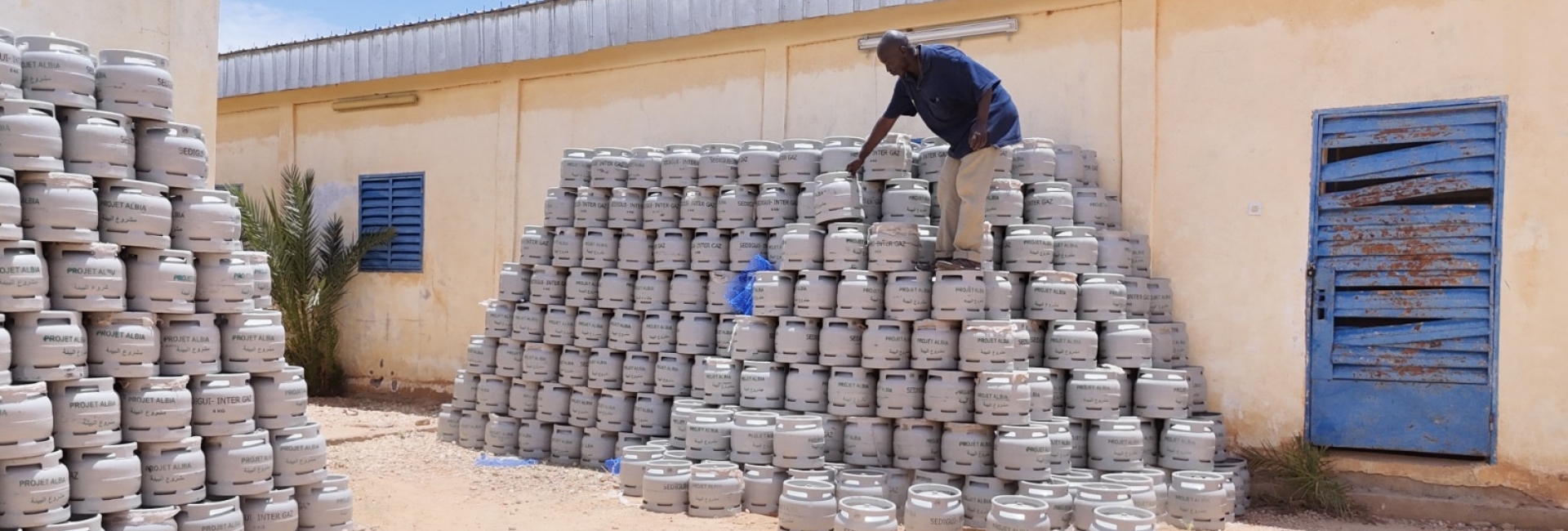
- World Bank, Local Development and Climate Change Adaptation Project (ALBIA)
- World Bank, Chad Energy Access Scale Up Project (PAAET)
- World Bank, Territorial Development and Resilience Project for Chad (ResiTchad)
- BMZ & EU, Energy and socio-economic resilience for people in refugee situations and host communites in Chad (RECOS)
- European Union, EU-INTPA Strengthening community resilience through improved livelihoods and access to basic services for vulnerable and displaced communities affected by conflict and climate-change
Recommendations and Priority Investments
- Expand access to electricity, clean cooking solutions, and solar energy for households and community facilities.
- Invest in climate-resilient farming, reforestation, land restoration, and sustainable land management. For more information, see Agriculture & Food Security in Chad (forthcoming).
- Strengthen early warning systems, flood control, and water supply for refugees and host communities. For more information, see WASH in Chad.
- Coordinate humanitarian, development, and peace programming towards the adoption of a climate-sensitive approach in support of national plans.
- Ensure climate finance reaches vulnerable communities without onerous conditions.
Key Resources
Contacts
UNHCR: Yves Amoussougbo, Senior Development Officer ([email protected])