
New CGIAR Research on Water and Agri-Food Systems, Resilience, and Bioeconomy in Eastern Sudan
New CGIAR Research on Water and Agri-Food Systems, Resilience, and Bioeconomy in Eastern Sudan
Sudan’s overlapping crises of conflict, displacement, climate stress, and service collapse have pushed millions of people into extreme vulnerability, placing unprecedented pressure on food, water, energy, and sanitation systems in refugee-hosting regions.
CGIAR is a global research partnership for a food-secure future dedicated to transforming food, land, and water systems in a climate crisis. Two CGIAR centers, the Alliance of Bioversity & the International Center for Tropical Agriculture (CIAT) and the International Water Management Institute, in partnership with UNHCR, are conducting research in selected refugee and IDP-hosting sites in Sudan. In April 2026, the joint research programme launches three new research publications.
Research Publication: Leveraging Circular Bioeconomy for Resilience in Sudan’s Refugee-Hosting Communities
This paper explores how circular bioeconomy approaches can transform these pressures into opportunities for resilience in three highly affected states: White Nile, Gedaref, and Kassala. Drawing on a desk-based assessment and evidence from comparable humanitarian contexts, the study identifies practical, low-infrastructure pathways that convert locally available organic waste and by-products into food, energy, soil inputs, and livelihoods. The analysis highlights five priority entry points: nutrient recycling for food system resilience; decentralized bioenergy for clean cooking and basic services; feed production for displaced livestock; small-scale wastewater reuse and greywater irrigation; and community-based bioproduct enterprises. Together, these pathways demonstrate how waste streams can be reframed as assets that strengthen self-reliance, reduce environmental degradation, and ease pressure on overstretched humanitarian systems.
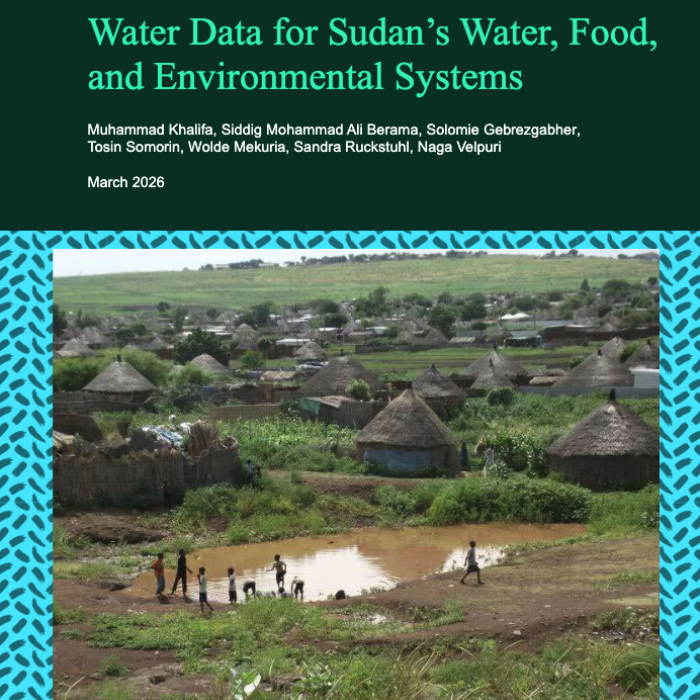
Working Paper: Water Data for Sudan’s Water, Food, and Environmental Systems
This project supports three objectives: (i) identifying priority locations for improving water interventions around displacement sites across Gedaref, Kassala, and White Nile States; (ii) assessing land and vegetation conditions that influence food production, livelihoods and settlement planning; and (iii) understanding exposure to climate risks that affect displaced persons and host communities. The Working Paper presents results for three use cases in Gedaref, Kassala, and White Nile States. It also shows how these data layers can inform biophysical assessments and support both effective resource allocation and early recovery planning where ground access is limited.
Policy Brief: Agriculture and Water Systems in Sudan: Opportunities for Refugee and IDP Integration
This policy brief covers Gedaref, Kassala, and White Nile States and assesses: (1) National characteristics of Sudan’s agri-food system; (2) Overview of Eastern Sudanese agri-food systems; (3) Refugee and IDP integration into agri-food systems in Eastern Sudan, and (4) Governance systems and approaches to agricultural production in Eastern Sudan.
Secondly, the brief analyses the needs for an enabling environment for agricultural production and outlines the roles for humanitarian and development actors, local and state authorities, and private sector companies and value chains.
This work is carried out with support from the Climate Action Science Program (CASP), and the CGIAR Food Frontiers and Security (FFS) Science Program. We would like to thank all funders who supported this research through their contributions to the CGIAR Trust Fund. For more information, please contact Dr. Radhika Singh ([email protected]) and Dr. Wolde Bori Mekuria ([email protected]).