Agriculture and Food Security
Agriculture and Food Security
On this page
Responding to the Sudan Regional Crisis
Forced displacement crises – including those involving refugees, IDPs, and returnees – entail humanitarian, development and peace challenges that require food security, resilience-building, and peace-responsive interventions at an early stage.
The Sudan conflict’s impact on food security is severe. In Sudan, between October and November 2024, famine struck five regions, including Zamzam, Abu Shouk, and Al Salam IDP camps in North Darfur. According to the Integrated Food Security Phase Classification (IPC), over 60% of the assessed IDP camps were highly food insecure (IPC Phase 3 and above), while in Zamzam IDP camp alone, 95% of the assessed population was in IPC Phase 3+. In neighboring countries, refugees, returnees and host communities face alarmingly high rates of malnutrition and food insecurity. In Chad, nine out of nine assessed refugee sites in the provinces of Ennedi Est, Ouaddai, Sila and Wadi Fira, which host large Sudanese refugee populations, are highly food insecure (IPC Phase 3 and above), according to the March 2025 IPC report.
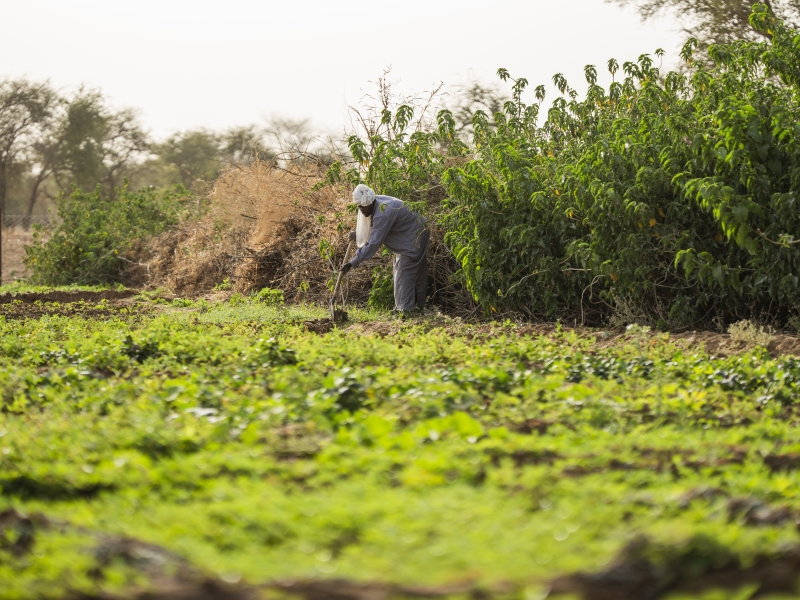
Many Sudanese refugees in Uganda, Chad, Ethiopia and South Sudan come from agricultural backgrounds, bringing with them valuable skills and experience in farming and rural livelihoods. Despite this, displaced populations are often among the most food-insecure and vulnerable in the region, and their numbers continue to rise. The loss of access to land and agricultural inputs are just the beginning of the barriers that compromise resilience, and limit agriculture activities for displacement affected communities.
Zoom in: The FAO’s Approach to Forced Displacement
The Food and Agriculture Organization of the United Nations (FAO) plays a critical role in supporting both displaced and host communities to restore and rebuild agriculture-based livelihoods. As a key actor in implementing the humanitarian–development–peace nexus (HDP) approach, FAO places agricultural interventions at the centre of its efforts to enable durable solutions to displacement. Learn more.
Data
The FAO established the publicly available Data in Emergencies (DIEM) Information System in June 2020. Through the DIEM-Monitoring Pillar, the FAO collects, analyses and disseminates data to inform decision-making by providing updated information on how different shocks affect the livelihoods and food security of agricultural populations. For countries responding to the Sudan crisis, the DIEM platform provides data and analysis for the Central African Republic, Chad, South Sudan, and Sudan.
View key indicators for the Sudan. For more information and to view key indicators for other countries, visit DIEM Monitoring.
The Integrated Food Security Phase Classification (IPC) provides standardized, evidence-based assessments of acute food insecurity, helping to identify areas and populations in greatest need during the Sudan emergency. IPC phases range from Minimal (Phase 1) to Famine/Catastrophe (Phase 5), indicating the severity of food insecurity and guiding humanitarian response priorities.
Integrated Food Security Phase Classification
Sudan
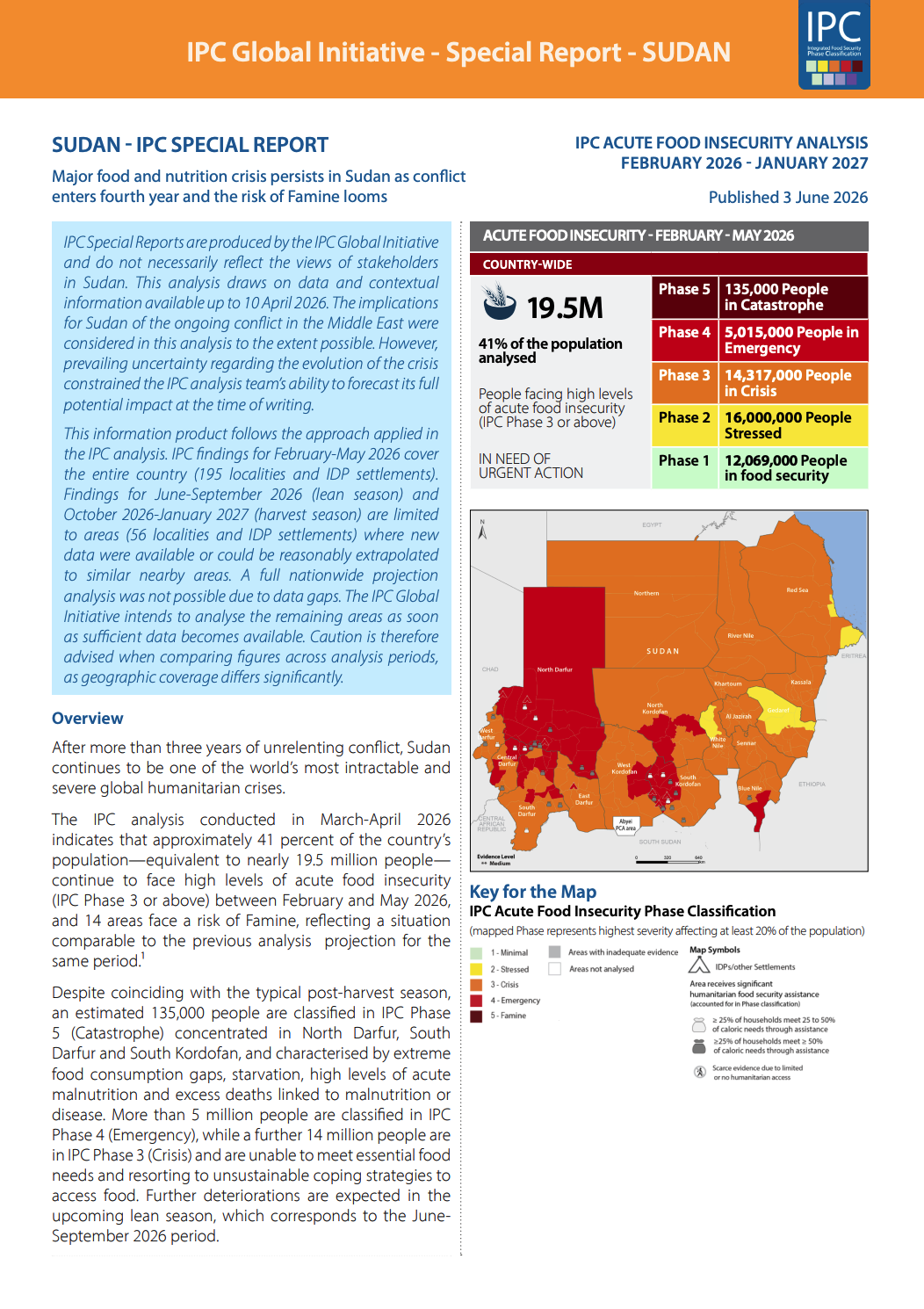
IPC Sudan Acute Food Insecurity | September 2025 – May 2026
This IPC Special Snapshot highlights that famine (IPC Phase 5) is ongoing and expected to persist through January 2026 in El Fasher and Kadugli towns, and 20 areas across Greater Darfur and Greater Kordofan are at risk of Famine. The full IPC analysis report is forthcoming.
IPC Sudan Acute Food Insecurity Situation | Oct 2024 – May 2025
Famine (Phase 5) confirmed in at least five areas, including Zamzam, Abu Shouk, and Al Salam IDP camps in North Darfur. Overall, 24.6 million people (50% of the assessed population) face Crisis or worse (Phase 3+), including 638,000 in Catastrophe (Phase 5). Drivers include ongoing conflict, large-scale displacement, market disruptions, and collapsing cereal production. Humanitarian access remains severely constrained.
Chad
The acute malnutrition situation in Chad remains similar to the situation last year (2023-2024) with slight variations.
FEWS NET Chad: Food Security Outlook | October 2024 – May 2025
Eastern Chad, hosting large numbers of Sudanese refugees, shows sustained Crisis-level (Phase 3) food insecurity
South Sudan
IPC Acute Food Insecurity & Malnutrition | April – July 2025
Approximately 7.7 million people (~57% of the analysed population) are facing Phase 3+ acute food insecurity, with 46,000 additional people newly classified as severely food insecure compared to previous estimates. Additionally, 85% of people returning to South Sudan after fleeing the conflict in Sudan are likely to face high levels of acute food insecurity.
Ethiopia
FEWS NET Ethiopia: Food Security Outlook | October 2024 – May 2025
Acute food insecurity remains high across northern, eastern, and pastoral/semi-pastoral areas. Many zones face Crisis (Phase 3) outcomes, with Emergency (IPC Phase 4) conditions in the north. Drivers include conflict, localized droughts, poor harvests, and rising food prices.
Uganda
IPC Uganda Acute Food Insecurity | April 2025 – February 2026
Food insecurity is concentrated in northern districts including Adjumani, Arua, and Lamwo, which host large numbers of Sudanese refugees. For Aug 2025–Feb 2026, approximately 1.42 million people are projected in Phase 3+.
Countries & Settlements
Document Library
Contacts
FAO: Andrea Berloffa, Senior Emergency and Rehabilitation Officer ([email protected])