Policy & Legal
Policy & Legal
On this page
Countries on the frontline of the Sudan emergency have, overall, adopted generous and welcoming policies toward refugees fleeing the conflict in search of safety. Sustained international support remains essential to uphold these policy commitments in practice. This page provides a snapshot overview of refugee rights across the eight countries responding to the crisis and highlights key resources for policy and legal analysis. These include the UNHCR Rights Mapping and Analysis Platform, the Global Refugee Forum Pledges & Contributions Dashboard, and the Dataset of World Refugee and Asylum Policies (DWRAP) — developed in collaboration with the World Bank–UNHCR Joint Data Center on Forced Displacement.
Rights Mapping and Analysis Platform
The Rights Mapping and Analysis Platform (RiMAP) is an online platform that provides country-specific information on access to rights and solutions for forcibly displaced and stateless persons. It maps international legal instruments, domestic laws and policies and offers analysis of these laws and their implementation. Through its research and country-specific insights, RiMAP aims to shed light on the legal context for refugees, internally displaced persons, and stateless persons, enabling the identification of gaps in law and practice, thereby promoting and supporting advocacy for law and policy reforms to better protect forcibly displaced and stateless persons.
Key components of RiMAP are the Refugee Treaty and Legislation Dashboard and the IDP Law and Policy Dashboard, which present essential data on treaties and national legislation relevant to refugees and internally displaced persons. A similar database for stateless persons is under development.
Snapshot of Refugee Rights
Country | Signatory to 1951 Refugee Convention & 1967 Protocol | Signatory to 1969 OAU Refugee Convention | National Asylum Law | Refugees have the right to work | Refugees have freedom of movement | Refugees have access to national health & education | |
Central African Republic | Yes | Yes | Law No. 07.020 (2007) | Yes | Yes | Yes | |
Chad | Yes | Yes | Law No. 027/PR/2020 | Yes | Yes | Yes | |
Egypt | Yes | Yes | Law No. 164 of 2024 on the Asylum of Foreigners was enacted on 16 Dec 2024 | Yes* | Yes* | Yes* | |
Ethiopia | Yes | Yes | Refugees Proclamation No. 1110 (2019) | Yes | Yes | Yes | |
Libya | No | No | No national asylum law | No | No | No | |
South Sudan | Yes | Yes | Refugee Act (2012) | Yes | Yes | Yes | |
Sudan | Yes | Yes | Asylum Act (2014) | Yes | Yes | Yes | |
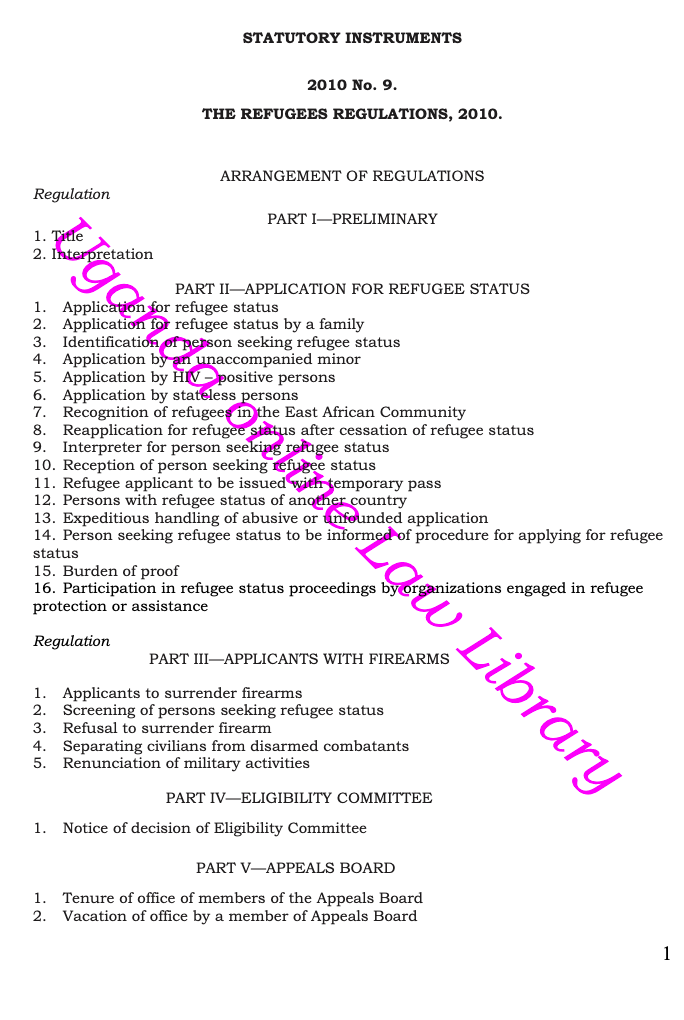
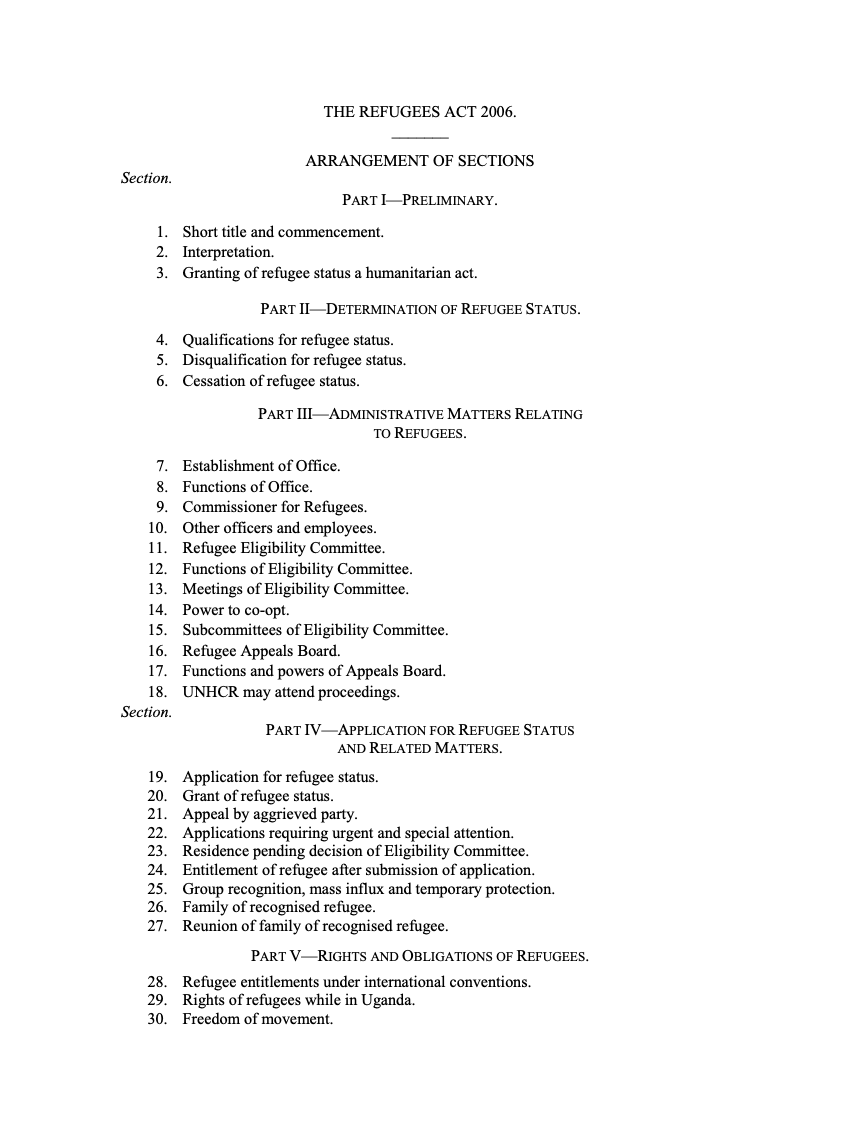
Uganda | Yes | Yes | Refugees Act (2006) | Yes | Yes | Yes |
Notes: “Yes*”, the asylum law recognises this right, however, existing and/or missing secondary legislation as well as administrative and/or practical barriers affect effective access.
Countries

The countries hosting Sudanese refugees are all members of a Regional Economic Community (REC). Ethiopia, Sudan and South Sudan are all members of the Intergovernmental Authority on Development (IGAD), whereas South Sudan and Uganda are also Partner States of the East African Community (EAC). These RECs have developed various frameworks and policies that anchor protection and solutions.
Regional Protection and Solutions Frameworks
IGAD Frameworks
- IGAD Plan of Action (2017–2020, extended): Operationalizes the Nairobi Declaration that calls for: (1) Inclusion of refugees in national development plans and sectoral systems (education, health, employment); (2) Harmonization of refugee management policies across IGAD Member States; (3) Data sharing and joint programming on durable solutions.
- IGAD Support Platform for the Nairobi Process: Launched in 2019 as a mechanism to mobilize political, technical, and financial support for the Nairobi Process. It anchors inclusion efforts in a whole-of-society and whole-of-government approach, linking humanitarian and development actions.
- IGAD Regional Education Policy Framework (2021): Promotes access to quality education for refugees, returnees, and host communities, and encourages recognition of qualifications and cross-border education continuity.
- IGAD Regional Framework on Free Movement of Persons (under development/adoption): Builds on the 2012 IGAD Protocol on Free Movement of Persons and aims to facilitate cross-border mobility of refugees and other persons for work, education, and trade.
EAC Frameworks
- EAC Treaty (1999): Provides a basis for regional cooperation on migration, social affairs, and human rights. Articles 104 and 120 promote free movement of persons and social integration, which can be extended to refugees.
- EAC Common Market Protocol (2010): Establishes rights to move, reside, and work within Partner States. While primarily for citizens, it provides a legal and policy precedent for refugee inclusion initiatives and advocacy for complementary pathways.
- EAC Regional Refugee Management Policy (draft): Currently under discussion. Aims to harmonize asylum systems, promote refugee inclusion, and facilitate mobility within the region. Envisions linking national refugee frameworks to the EAC Common Market freedoms.
- EAC Vision 2050 and 6th Development Strategy (2021–2026): Undergoing updates for 2027-2032. Recognize the need for inclusive growth and human development. Offer entry points to mainstream displacement and statelessness issues in the regional integration agenda.
- EAC Gender and Social Development Frameworks: Address vulnerable groups, including displaced persons, within broader social protection, education, and health initiatives.
Complementary Regional and Global Linkages
Both IGAD and EAC frameworks align with: the Global Compact on Refugees (GCR) — emphasizing inclusion and burden-sharing; the Comprehensive Refugee Response Framework (CRRF) — operationalized through IGAD’s regional commitments; and the African Union’s Kampala Convention (2009) — guiding protection and durable solutions for displaced persons.
Dataset of World Refugee and Asylum Policies (DWRAP)
The Dataset of World Refugee and Asylum Policies (DWRAP) offers a complete dataset of de jure asylum and refugee policies for all 193 countries for the 70 years from 1951-2022. Explore what policies are in place and how these policies have shifted over the past seven decades. The DWRAP index aggregates policies from 5 fields: Access; Services; Livelihoods; Movement, and Citizenship and Participation; with values ranging from 0 to 1, where values closer to 1 indicate more liberal policies. Click here to go to the analysis page, where you can use different inputs to create a variety of plots and explore policy trends over time. DWRAP was developed by Blair, Grossman and Weinstein (2022) and has been updated in collaboration with the World Bank – UNHCR Joint Data Center on Forced Displacement.
Pledges at the Global Refugee Forum
The Governments of the Central African Republic (CAR), Chad, Egypt, Ethiopia, South Sudan, Sudan, and Uganda have collectively made 63 pledges at the Global Refugee Forums in 2019 and 2023, demonstrating strong regional commitment to advancing refugee rights and inclusion. To date, 9 pledges have been fulfilled, and 21 are open for matching support. These pledges reflect a wide range of priorities – from economic inclusion and education to asylum systems and peacebuilding. For example:
- Uganda has pledged to create at least 300,000 viable economic opportunities for refugees and host communities by 2027.
- South Sudan has committed to strengthening national asylum system capacity by 2027.
- Chad and Egypt have made important pledges to advance refugee inclusion in national health and education systems.
- The Central African Republic has focused its commitments on peacebuilding and social cohesion.
- Ethiopia co-leads the Multi-Stakeholder Pledge on Sustainable Human Settlements, supporting urban and rural areas that are designed, developed, and governed in ways that seek to create safe and resilient communities for displaced people and hosts.
All government pledges can be viewed on the Pledges & Contributions Dashboard.
Document Library
Contacts
UNHCR: Kizitos Charloz Okisai, Senior Legal Officer ([email protected])