
Integrated Planning Framework Charts Way Forward for Farchana in Chad
Integrated Planning Framework Charts Way Forward for Farchana in Chad
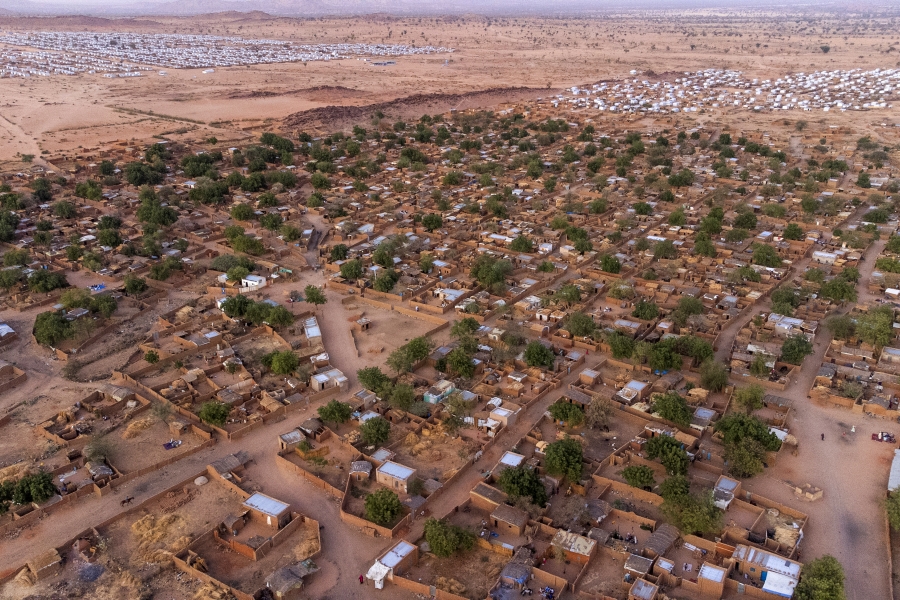
Farchana, Chad.
[Français ci-dessous]
Since April 2023, Chad has faced an unprecedented humanitarian crisis, marked by over 928,000 new arrivals and a total of 1.2 million Sudanese refugees living in Ouaddaï, Sila, Wadi Fira and Ennedi Est Provinces. These populations, made up mostly of women and children, have settled in rural areas already weakened by poverty, a lack of infrastructure and pressure on natural resources. The crisis has profoundly reshaped territorial and social dynamics. Sites that were initially temporary are turning into hubs of spontaneous urbanisation, driving accelerated demographic growth, land tensions, and mounting pressure on public services and resources. In response, the Government of Chad has adopted an integrated territorial approach aimed at transforming refugee and returnee sites into sustainable development poles, in line with the national decentralisation policy and the National Plan for Response to the Crisis in the East (2025–2027).
The Ministry of Land Management, Urbanism and Habitat (MATUH), with the support of UNHCR and UN-Habitat, has launched a technical collaboration to support integrated territorial planning in the areas affected by the Sudanese crisis and piloted the approach in Farchana, Ouaddaï Province. The objective is to provide Farchana with a strategic territorial planning framework that can guide its urban transformation and improve the resilience of both host and refugee communities. MATUH, UN-Habitat and UNHCR are pleased to announce the Integrated Planning Framework for Farchana, articulated in two volumes.
Volume I: Territorial Profile
The Territorial Profile establishes the evidence base for Farchana's transformation. It sets out the methodology for developing the diagnostic study, outlines the national and provincial context, and provides an institutional, economic, and urban analysis of the municipality. The Profile closes with a SWOT analysis of Farchana's strengths, weaknesses, opportunities, and threats.
Volume II: Strategic Vision and Action Plan
The Strategic Vision and Action Plan highlights three strategic challenges: (1) Environmental pressure and degradation of natural resources; (2) Managing spatial growth and basic services; and (3) Accessibility and regional connectivity. The Strategic Vision equips the municipality with long-term planning that reconciles social integration, land security, the management of urban growth, and environmental resilience. It also serves as a tool for territorial coherence and steering.
The Action Plan supports Farchana's rapid urban growth in a sustainable, inclusive, and resilient manner. Via a multidimensional approach, it identifies concrete measures that integrate residential areas, refugee reception centres, agricultural and pastoral zones, economic hubs, and key infrastructure - phased and coordinated across time and space to trigger the expected spatial, economic and social transformations. Finally, a Strategic Investment Plan turns vision into next steps. The investment plan details key projects and supporting actions for each thematic area, specifying expected impact, stakeholders involved, and estimated costs.
Looking Ahead
Taken together, the Integrated Planning Framework for Farchana progresses from diagnostic study, to long-term vision and planning, and finally to costed investment. The model offers a replicable methodology beyond Farchana for other rural municipalities hosting refugees and returnees across eastern Chad.
For more information, read the full reports and contact Dr. Play Hermès D'Ameuno Sare, UN-Habitat ([email protected]).
Version Française
Depuis avril 2023, le Tchad est confronté à une crise humanitaire sans précédent, marquée par plus de 928,000 nouvelles arrivées et un total de 1,2 million de réfugiés soudanais vivant dans les provinces du Ouaddaï, du Sila, du Wadi Fira et de l'Ennedi Est. Ces populations, majoritairement composées de femmes et d'enfants, se sont installées dans des zones rurales déjà fragilisées par la pauvreté, le manque d'infrastructures et la pression sur les ressources naturelles. La crise a profondément transformé les dynamiques territoriales et sociales : des sites initialement temporaires se muent en noyaux d'urbanisation spontanée, entraînant une croissance démographique accélérée, des tensions foncières et une pression accrue sur les services publics et les ressources. En réponse, le Gouvernement tchadien a adopté une approche territoriale intégrée visant à transformer les sites de réfugiés et de retournés en pôles de développement durables, en cohérence avec la politique nationale de décentralisation et le Plan national de réponse à la crise dans l'Est (2025–2027).
Le Ministère de l'Aménagement du Territoire, de l'Urbanisme et de l'Habitat (MATUH), avec l'appui du Haut-Commissariat des Nations Unies pour les Réfugiés (HCR) et du Programme des Nations Unies pour les Établissements humains (ONU-Habitat), a engagé une collaboration technique visant à accompagner la planification territoriale intégrée des zones affectées par la crise soudanaise, et a piloté cette approche à Farchana, dans la province du Ouaddaï. L'objectif est de doter Farchana d'un cadre de planification territoriale stratégique, afin d'accompagner sa transformation urbaine et d'améliorer la résilience des communautés hôtes et réfugiées. Le MATUH, ONU-Habitat et le HCR ont le plaisir d'annoncer le Document cadre de planification intégrée pour Farchana, articulé en deux volumes.
Volume I : Profil Territorial
Le Profil Territorial établit la base factuelle de la transformation de Farchana. Il présente la méthodologie d'élaboration du diagnostic, expose le contexte national et provincial, et fournit une analyse institutionnelle, économique et urbaine de la commune. Le Profil se conclut par une analyse SWOT des forces, faiblesses, opportunités et menaces de Farchana.
Volume II : Vision Stratégique et Plan d'Actions
Volume II, Vision Stratégique et Plan d'Actions, met en évidence trois enjeux stratégiques : (1) la pression environnementale et la dégradation des ressources naturelles ; (2) la gestion de la croissance spatiale et des services de base ; et (3) l'accessibilité et la connectivité régionale. La Vision Stratégique dote la commune d'une vision d'aménagement à long terme, conciliant intégration sociale, sécurité foncière, gestion de la croissance urbaine et résilience environnementale. Elle constitue également un outil de cohérence territoriale et de pilotage.
Le Plan d'Actions accompagne la croissance urbaine rapide de Farchana de manière durable, inclusive et résiliente. À travers une approche multidimensionnelle, il définit des mesures concrètes qui intègrent les zones résidentielles, les centres d'accueil des réfugiés, les zones agricoles et pastorales, les pôles économiques et les infrastructures clés — échelonnées et coordonnées dans le temps et l'espace afin de déclencher les transformations spatiales, économiques et sociales attendues. Enfin, un Plan d'Investissements Stratégiques traduit la vision en étapes concrètes. Le plan d'investissements détaille, pour chaque domaine thématique, les projets clés et les actions d'accompagnement, en précisant leur impact attendu, les parties prenantes concernées et leurs coûts estimés.
Prochaines étapes
Pris dans leur ensemble, le Document Cadre de Planification Intégrée pour Farchana progresse du diagnostic à la vision et à la planification à long terme, puis à l'investissement chiffré. Le modèle offre une base méthodologique reproductible au-delà de Farchana, pour d'autres communes rurales accueillant des réfugiés et des retournés à l'Est du Tchad.
Pour plus d'informations, consultez les rapports complets et contactez le Dr Play Hermès D'Ameuno Sare, ONU-Habitat ([email protected]).